Contents
Lipolysis injections can help eliminate localized fat and create beautiful body contours, but can they fail? What are the contraindications? Is massage needed afterward? This article explains the possible reasons a lipolysis injection fails, introduces the precautions before and after treatment and the contraindications, and helps you sculpt your figure effectively while avoiding the risk of failure.
What are lipolysis injections?
- How they work
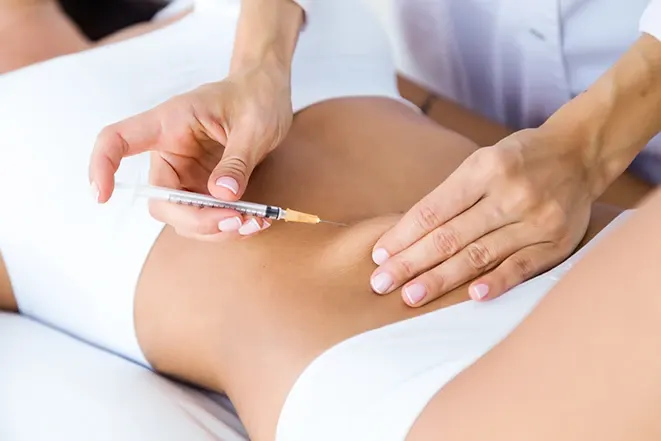
Lipolysis injections work by injecting a medication into the subcutaneous tissue that acts on fat cells to destroy them, emulsifying the fat cells (breaking them down into small particles) and triggering an inflammatory reaction in the treated area. The particles are metabolized by macrophages in the body, carried through the lymphatic vessels to the liver, broken down into carbon dioxide and water, and then excreted, in order to achieve local fat reduction and sculpting, suitable for small areas of superficial fat.
- Suitable areas
- Advantages
Possible rejection-type reactions after lipolysis
In the early stage when the lipolysis injection destroys fat, the injected area and the surrounding skin will have an immune rejection reaction, with temporary swelling, and possible burning, pain, soreness, numbness, or lumps and depressions. However, these are normal parts of the fat-destruction process, and most improve within several days to weeks, and the number of days of swelling shortens as treatments accumulate.
In addition, it is also possible for the skin to become uneven because fat is destroyed to varying degrees.
Many people worry about lipolysis injection failure or after-effects. However, countries around the world have widely used PC/DC ingredients in fat-reduction treatments for many years, and statistics and reports in many foreign studies confirm that lipolysis injections are a safe and effective way to remove localized fat. As long as contraindications are avoided in advance, aftercare principles are followed carefully, and a professional doctor performs the injection, failed lipolysis injections or serious after-effects are rare.
3 main reasons lipolysis injections fail
Reason 1: Incorrect injection placement
Everyone's body shape and the areas they want to slim differ, so lipolysis treatment must be planned in a customized way, and the injection depth and location must be assessed by a professional doctor. If there is not enough communication with the doctor before treatment, or if the doctor's technique is not skilled and the needle goes too deep or too shallow, the lipolysis injection may fail.
Reason 2: Too much or too little dose
Because lipolysis injections rely on your own immune system to clear the destroyed cells through liver metabolism, the dose has a certain range. Too much may put too heavy a burden on the liver, leaving the body in poor condition and unable to achieve the intended effect, while too little may also leave the treatment ineffective.
Reason 3: Incorrect needle spacing
Lipolysis injections have a standard needle density. If the doctor lacks experience and skill and does not get the needle spacing right, it can affect the results, and in serious cases it can cause the injection to fail.
To avoid failure, the doctor's injection technique is key. We recommend choosing an experienced, skilled doctor, and fully communicating with the doctor before treatment to achieve the fat reduction you want.
Contraindications and pre-treatment precautions
- Contraindications
- Pre-treatment precautions
Aftercare and massage after lipolysis injections
The inflammatory reaction after a lipolysis injection normally causes redness, swelling, and small hard nodules, and most recover after the recovery period. In a few cases, subcutaneous tissue fibrosis occurs, leading to depressions and lumps. If lumps or nodules appear, the following 2 methods can help resolve them:
1. Local massage
Subcutaneous lumps are mostly caused by incomplete absorption of the fat-dissolving medication. Once swelling has subsided, local massage can promote blood circulation and speed the disappearance of the lumps. Note, however, that you must not press on the area before the swelling subsides, otherwise the hematoma may get worse.
2. Warm compress
When there are subcutaneous nodules, a warm compress also promotes blood circulation and stimulates the breakdown and elimination of the nodules.
If a subcutaneous nodule is large and continues to grow, return to the clinic as soon as possible so the doctor can assess the situation and manage it.
In general, patients who have just had a lipolysis injection treatment will have localized pain and bruising, and mild redness, swelling, and itching may also appear within a week as part of the inflammatory reaction. Pain usually decreases after about 3-5 days, and most patients return to normal after 7 days.
- Post-treatment precautions
This article is for general information only. Results vary from person to person; please consult a doctor in person before deciding on any treatment.