Contents
Unhappy with the shape of your nose? Or born without a nasal bridge? Do you envy people with high, straight noses but shy away from rhinoplasty surgery? This article rounds up the 3 main rhinoplasty methods and tells you which one suits you. It also includes the most complete comparison table so you can easily see the differences between the 3 treatments!
What Is 4D Minimally Invasive Rhinoplasty?
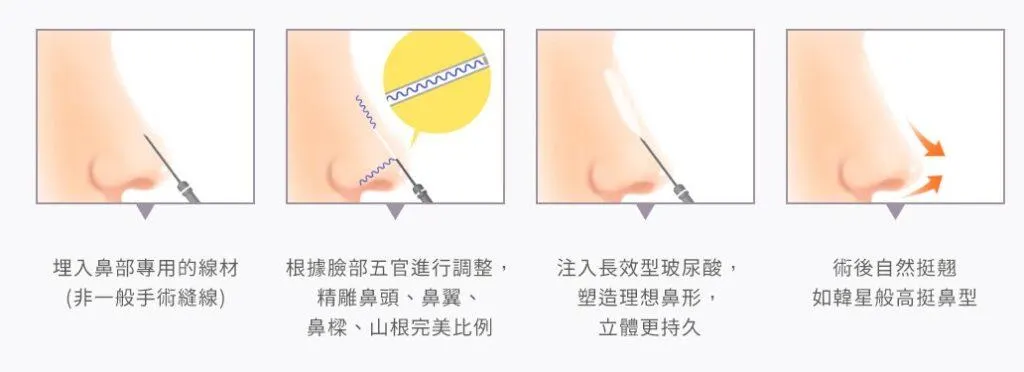
4D minimally invasive rhinoplasty is also known as “nose thread sculpting,” “thread rhinoplasty,” and so on. It is a procedure that inserts absorbable, nose-specific protein threads into the nose through a needle puncture, then uses the barbed design of the threads and the doctor's placement angle, followed by an injection of long-lasting hyaluronic acid, to shape the nose by point, line, and surface. Simply put, it is like the steel framework in a building: the nose-specific protein threads are the rebar and the hyaluronic acid is the concrete. The threads hold up the structure, and the hyaluronic acid fills in and sculpts.
4D minimally invasive rhinoplasty requires no incision and leaves tiny wounds, little bleeding, and almost no scarring, yet it can raise the nasal root and refine the nasal tip and other parts of the nose. The natural, lifted result is visible immediately after the procedure, lasts 2-3 years, and the procedure takes only 30 minutes.
Best for: People unhappy with their nose shape (e.g., an upturned or flat nose), people born without a nasal bridge (nasal root) or with a short nose, people afraid of surgery, and people whose bridge became too wide from filler injections
What Is Hyaluronic Acid Rhinoplasty?

The hyaluronic acid used in rhinoplasty is basically high-molecular-weight hyaluronic acid, which has stronger support and is suited to contour sculpting. Once injected, it fills hollows, adds volume to the tissue, and gives a full, plump look. Injected into the nose, it can improve a flat or collapsed nose, adjust the bridge, raise the nasal root, and refine a hooked nose; injected into the tip, it can lift and firm the tip and reduce visible nostrils; injected into the columella, it can correct a retracted columella, visually making the nostrils and alae look smaller.
Like 4D minimally invasive rhinoplasty, hyaluronic acid rhinoplasty requires no incision and leaves tiny wounds, little bleeding, and almost no scarring, but it needs regular re-injection, lasts about 6-12 months, and offers limited adjustment of the nose shape.
Best for: People with decent nose structure who want to fine-tune the shape, people afraid of rhinoplasty surgery, people who want to preview the result before surgery, people who want to improve fine details, and people who want to return to daily life right after the treatment
What Is Rhinoplasty Surgery?

Rhinoplasty surgery is mainly divided into one-stage traditional rhinoplasty, two-stage Korean-style rhinoplasty, and three-stage structural rhinoplasty.
One-stage traditional rhinoplasty: An I-shaped or L-shaped implant is placed inside the nose to build height, suited to people who already have a nasal root but want a higher, straighter bridge. Traditional rhinoplasty is inexpensive and the surgery is relatively simple, but the implant is noticeable, and a small number of people face a risk of the implant pushing through.
Two-stage Korean-style rhinoplasty: An I-shaped or L-shaped implant is placed inside the nose to build height, and the patient's own ear cartilage is used to build the curve of the tip, which not only looks more natural but, because the ear cartilage cushions the tip, also greatly lowers the risk of the implant pushing through, and can make the tip sharper, more upturned, and cuter.
The surgery uses a “closed approach,” which has the advantage that the wounds are sutured on the inside of the nostrils, leaving almost no scar after recovery. The drawbacks are limited malleability and the inability to perform complex nasal corrections; it suits people who want a high, straight bridge.
Three-stage structural rhinoplasty: It works on three parts, the nasal bridge, columella, and nasal tip, with the implant “cut into segments” to raise the bridge, allowing the nose shape to be substantially adjusted for different problems, and the patient's own ear cartilage used to build the curve of the tip, refining the nasal tip, sculpting the tip and alae at the same time, and correcting problems such as a deviated septum.
The surgery uses an “open approach,” with the incision made across the columella, which allows fine sculpting of complex nose shapes such as a very low bridge, overly wide alae, or an upturned nose. The advantage is high malleability: it can be fully customized to your needs to sculpt the perfect nose shape for you.
4D Minimally Invasive vs. Hyaluronic Acid vs. Surgical Rhinoplasty Comparison Table
| 4D minimally invasive rhinoplasty | Hyaluronic acid rhinoplasty | Rhinoplasty surgery | |
|---|---|---|---|
| Material | Collagen threads + long-lasting hyaluronic acid | Hyaluronic acid | Implant / autologous tissue |
| Procedure time | 30 minutes | 15-30 minutes | About 2-3 hours |
| Recovery | Short, almost no downtime | Short, almost no downtime | About 3-4 weeks |
| Results | Thread-shaped contour, better support | Limited by the material, weaker support | Better support |
| Duration | About 2-3 years | About 6-12 months | Permanent |
| Risks | Possible infection | Possible vascular occlusion | A small number of people face a risk of the implant pushing through |
| Advantages | Good for people who want a change but fear surgery | Good for people who want a change but fear surgery | Permanent |
| Cost | ** | * | *** |
How to Choose the Right Rhinoplasty Method?
When considering rhinoplasty, first be clear about your needs and expectations: the nose shape you want, the problems you want to fix, whether you want a quick change or a once-and-for-all solution, your budget, and so on. Once you are clear, consult a professional medical facility, talk with the doctor about the result you want and the problems you want to improve, and, with the doctor's professional advice, choose the rhinoplasty method and material that suit you. If you are afraid of surgical risks or unsure how the surgery will turn out, you can first try hyaluronic acid rhinoplasty or 4D minimally invasive rhinoplasty to preview, through a minimally invasive approach, the result of rhinoplasty surgery.
Choosing a rhinoplasty method is a lot like choosing clothes that fit. Whichever method you choose, the point is to find what suits you best. Everyone has different needs and a different constitution, so there is no need to follow trends blindly; instead, understand the characteristics of each method. We hope this article helps you understand rhinoplasty methods better.
This article is for general information only. Results vary from person to person; please consult a doctor in person before deciding on any treatment.