Contents
Eyes are the window to the soul. Beyond size, what makes eyes attractive is their expression, and a well-defined double eyelid is the key to captivating eyes. Many people with hidden creases or single eyelids have used eyelid tape or glue to create a crease, but repeatedly sticking on and peeling off the tape is a main cause of eyelid allergies and speeds up eyelid aging and sagging. Surgery is the best way to get a natural-looking double eyelid, but there are two types, incisional and suture. How do they differ, and how should you choose? This article answers the most common questions in one place.
Double eyelid surgery is done in two ways: incisional and suture. The main difference is the size of the incision. In incisional double eyelid surgery, a curved incision is made in the upper eyelid and an appropriate amount of orbital fat is removed, so the incision is larger. Suture double eyelid surgery also opens the skin, but with much smaller incisions, through which some orbital fat can be removed. Because the incisions are small, it is often called “scarless” double eyelid surgery, but here “scarless” means “a smaller wound,” not “no wound at all.”
Incisional Double Eyelid Surgery
- Best for: People with drooping skin around the eyes or sunken eye sockets
- Recovery: About 1-2 weeks (varies from person to person)
- Pros: Can adjust the structure of the upper eyelid tissue and keep the crease permanently
- Cons: Longer recovery after surgery, and a thin, long scar
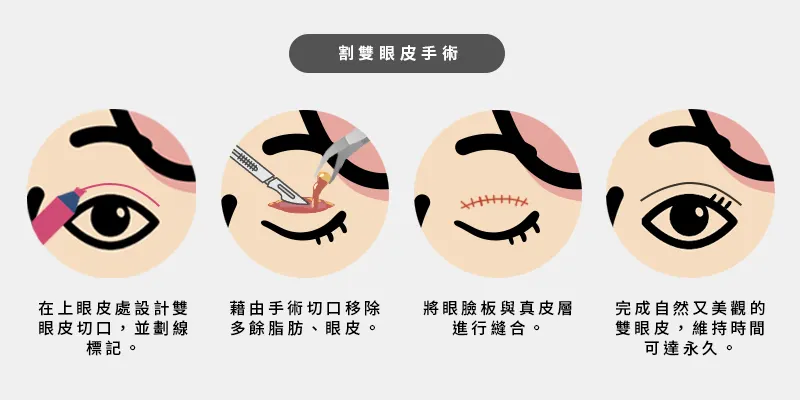
In incisional double eyelid surgery, a curved incision is made in the eyelid, an appropriate amount of excess orbital fat is removed, and a more attractive crease is created. It suits people with drooping skin around the eyes or sunken eye sockets. The results are very good: it can adjust the structure of the upper eyelid tissue and make the eyes look more dimensional, and it is the most effective and stable of all double eyelid methods. The downsides are more noticeable swelling after surgery, a longer recovery, and a thin, long scar on the eyelid.
The crease created by incisional surgery is more stable than one created by suture surgery and can last permanently. Although the crease may gradually soften over time, it stays on the eyelid and does not disappear, making this a relatively permanent, once-and-for-all approach.
Suture Double Eyelid Surgery
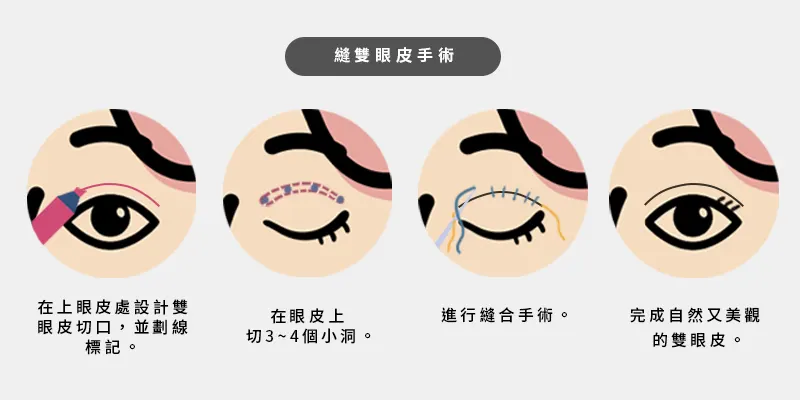
Suture double eyelid surgery makes a few small puncture points in the eyelid and uses very fine sutures to create an attractive curve and crease. The result is natural, the wounds are small, and recovery is short, with swelling going down in about 3-5 days.
However, suture double eyelid surgery is not right for everyone. It is only suitable for people with thin eyelid skin, no puffy eyelids, and no loose eyelid skin. In addition, the crease from suture surgery may disappear because the sutures loosen, the fat is thicker, or the eyelids age over time, so it cannot keep the crease permanently once and for all.
Staple-Style Double Eyelid Surgery
- Best for: People with thin eyelids and no drooping or loose eyelid skin
- Recovery: About 3-5 days (varies from person to person)
- Pros: More natural look, short procedure time, short recovery
- Cons: Does not last long, suitable for a limited range of patients
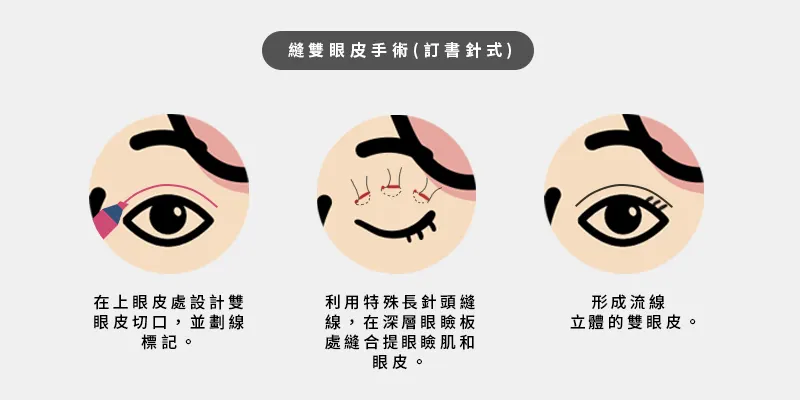
In staple-style double eyelid surgery, a small plate is pressed onto the eyelid to form several tiny holes, which let the doctor position and place the sutures. This avoids cutting the eyelid, combining the strengths of incisional and suture double eyelid surgery.
The wounds are only pinhole-sized, which greatly shortens recovery; you can go back to work the next day. But because the wounds are small, excess fat or skin cannot be removed, so it only suits people with thin eyelids, little fat, and no loose skin around the eyes. It is also prone to coming undone and does not last as long.
Three-Point Double Eyelid Surgery
- Best for: People with thin eyelids and no drooping or loose eyelid skin
- Recovery: About 3-5 days (varies from person to person)
- Pros: Can be revised multiple times if you are not satisfied
- Cons: The crease can look unnatural, suitable for a limited range of patients
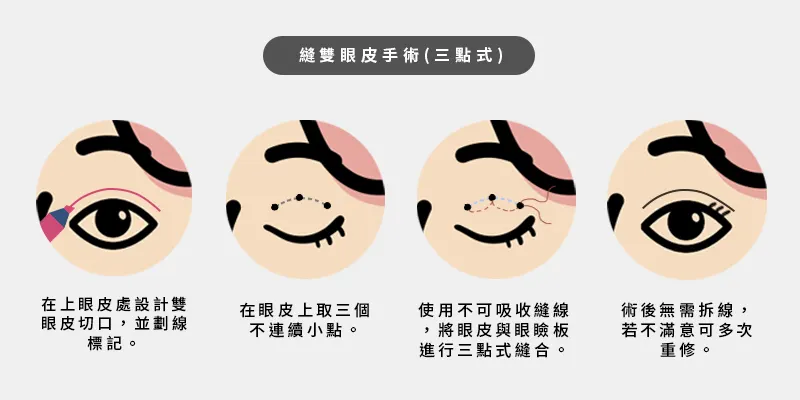
Three-point double eyelid surgery is the most common suture technique. It uses non-absorbable sutures to attach the eyelid skin to the tarsal plate at three points with fixed spacing, so the crease has the same depth from the inner corner to the outer corner of the eye.
The three-point method can be revised repeatedly, and if you are unhappy with the result, the sutures can simply be removed and redone. However, because the crease is uniform, it can look less natural, and since the incisions are small, excess fat or skin cannot be removed, which limits who it suits.
Figure-8 Suture Double Eyelid Surgery
- Best for: People with thin eyelids and no drooping or loose eyelid skin
- Recovery: About 3-5 days (varies from person to person)
- Pros: Secure sutures that rarely come loose, natural shape
- Cons: The suture is one continuous thread, so individual points cannot be adjusted locally; higher technical skill required
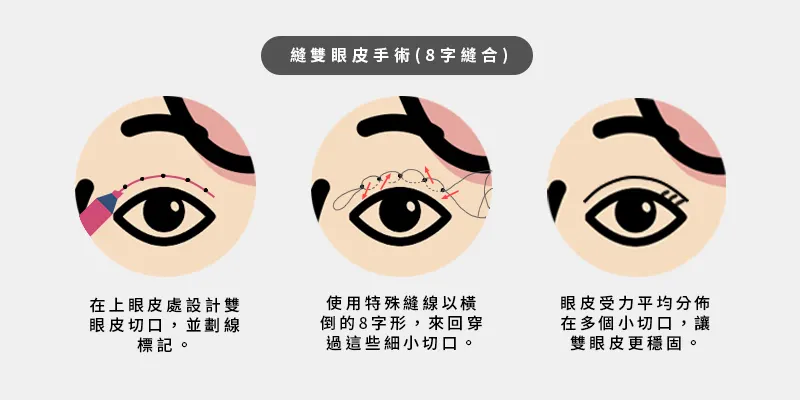
Figure-8 suture double eyelid surgery makes several tiny incisions in the upper eyelid and passes a special surgical suture through the eyelid in a sideways figure-8 pattern, running the same thread back and forth through these small incisions to form a natural crease line.
The figure-8 pattern spreads the tension on the eyelid evenly across several small wounds, making the result more secure and balanced. Besides looking more natural than conventional suturing, the evenly distributed tension means the sutures almost never loosen.
Comparing the 3 Suture Double Eyelid Methods
| Procedure | Staple-Style Double Eyelid | Three-Point Double Eyelid | Figure-8 Suture Double Eyelid |
|---|---|---|---|
| Best for | Thin eyelids, no drooping or loose skin | Thin eyelids, no drooping or loose skin | Thin eyelids, no drooping or loose skin |
| Recovery | About 3-5 days | About 3-5 days | About 3-5 days |
| Pros | Natural-looking crease | Can be revised multiple times | Secure sutures, natural shape |
| Cons | Crease does not last long | Crease can look unnatural | Higher technical skill required |
Incisional or Suture Double Eyelid Surgery: How to Choose?
Because of its larger incision, incisional surgery can handle looser, thicker eyelids and can be tailored to the eye shape. The crease is more defined and the result is once-and-for-all, but recovery is longer, with 1-2 weeks needed for swelling to go down.
Incisional surgery is recommended for older patients with excess eyelid fat, aging eyes, loose or drooping eyelids, or poor levator muscle function.
Suture double eyelid surgery has the advantages of less bleeding, no external scar, and a short recovery because the incisions are small. But the crease is less pronounced and does not last long, and not everyone is a good candidate for suture surgery.
Suture surgery is recommended for younger people with one single and one double eyelid, thin eyelids, little eyelid fat, and no obvious laxity.
| Procedure | Incisional Double Eyelid Surgery | Suture Double Eyelid Surgery |
|---|---|---|
| Procedure time | 1.5-2 hours | 30 minutes-1 hour |
| Recovery | 1-2 weeks | About 3-5 days |
| Advantages | Lasts longer Can remove excess fat or skin Can address more eye concerns | No external scar Short recovery No suture removal needed |
| Best for | Severe eyelid laxity Older patients | No excess fat around the eye, no eyelid laxity Younger patients |
This article is for general information only. Results vary from person to person; please consult a doctor in person before deciding on any treatment.