Contents
Puffy upper eyelids are a common concern among East Asians, making the eyes look dull and tired. Many people assume a tendency toward water retention is the cause, but the causes are actually varied and somewhat complex, mainly including excess fat, loose and drooping eyelids, bone structure, and eyeball prominence. Everyone’s situation is different, and the cause may well be a combination. This article explains what causes puffy eyelids and presents the common solutions.
1. Fat-Type Puffy Eyelids
Types of fat:
2. Drooping-Eyelid Puffy Eyes
If you gently lift the eyebrow upward and the heaviness below the brow and around the eye clearly disappears, it means there is not much orbital fat, and the cause of the puffy look may then be looseness and drooping of the tissue around the eyelid and brow. If the looseness covers a larger area, it may even extend to the forehead and scalp, which is laxity of the upper face tissue that also makes the eyelids look droopy, and the brow may even press down on the eye.

3. Bone-Type Puffy Eyes
If the heaviness remains after lifting the eyebrow, and what you feel is not soft fat but hard bone, the puffy look is caused by a more prominent, protruding brow bone, or by a naturally downward-pressing structure, and bone-type puffy eyes are more difficult to treat, so you need to discuss with your doctor how to adjust the eye shape in order to correct and change the shape.
4. Protruding-Eyeball Puffy Eyes
Some people may not have any of the problems of orbital bone structure, brow heaviness, or fatty soft tissue, yet still feel their eyelids are puffy and bulging. In this case it may be caused by more prominent eyeballs, as with people who have high myopia or hyperthyroidism, whose eyelids wrap around protruding eyeballs and look puffy from the side. And for protruding-eyeball puffy eyes, orbital fat removal is not recommended, because once the orbital fat is removed, the eyeballs may look even more prominent and the condition will not improve much.
Learn more: Why Do I Have Uneven Eyes? 3 Ways to Improve Them, and Surgery Isn't Always Needed!
Treating Puffy Eyes: Small-Incision Fat Removal + Suture Double Eyelid Surgery
If you have fat-type puffy eyelids and are the type with more fat on the lateral side, a small lateral incision for fat removal can be combined with suture double eyelid surgery to also eliminate the puffiness. Note, however, that if there is a lot of fat from the inner to the outer part of the lid, incisional double eyelid surgery is still needed to get a stable double eyelid.
Advantages of suture double eyelid surgery
Stapler-style suture double eyelid surgery
Also known as the Japanese-style double eyelid, it mainly uses an instrument introduced from Japan that resembles a stapler. A tiny notch is first made on the eyelid, and then a hooked needle is used to suture the upper eyelid, the levator palpebrae muscle, and the tarsal plate in a box-shaped stitch pattern.
The wound from stapler-style double eyelid surgery is only the size of a needle hole, which greatly shortens recovery. You can go back to work normally the next day. However, because the wound is small, excess fat or eyelid skin cannot be removed, so it is only suitable for people with thin eyelids, little fat, and no looseness of the skin around the eyes.
3D scarless double eyelid surgery
3D scarless double eyelid surgery sutures the eyelid to the fascia of the levator palpebrae muscle, then connects the stitches with a running-stitch technique and buries them in the orbicularis oculi muscle. It combines the advantages of suture and incisional double eyelid surgery, using a gentle technique to firmly tie the levator muscle, tarsal plate, and skin together. The wound is almost invisible after surgery, forming a natural double eyelid crease. It is not only suitable for any eye shape but can also improve a mild epicanthal fold, giving a visual effect similar to opening the inner corner of the eye. The double eyelid is not easily lost, and recovery is short!
[Case Study]
Learn more: Secrets to Captivating Eyes! Essential Knowledge About Double Eyelid Surgery
Treating Puffy Eyes: Incisional Double Eyelid Surgery
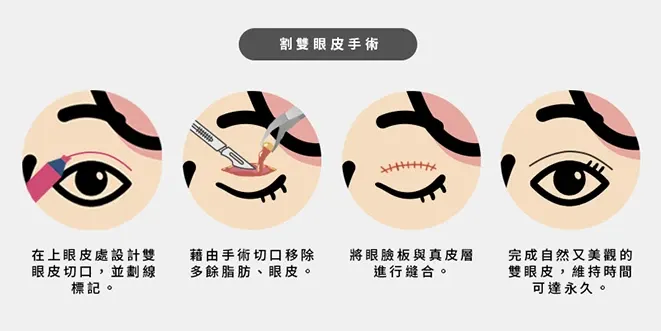
Incisional double eyelid surgery makes an arc-shaped incision in the eyelid, removes an appropriate amount of excess orbital fat to resolve the puffiness, and then creates a beautiful double eyelid crease. It suits people with thick orbital fat, excess eyelid skin, or drooping eyelids. It is currently the most effective and stable of the double eyelid techniques, but swelling after surgery is more noticeable and recovery is longer. The crease will gradually soften over time, and it is a permanent, once-and-for-all surgical method.
Advantages of incisional double eyelid surgery
Treating Puffy Eyes: Brow Lift Surgery
The forehead consists mainly of skin and subcutaneous soft tissue. Once it becomes lax, deep local wrinkles can develop, and in more severe cases it presses on the brow, which in turn presses on the eye, creating heavy brows that weigh down on the eyes.
Brow lift surgery is an endoscopic procedure that lifts the loose, sagging deep subperiosteal tissue back up, restoring firmness and radiance to the skin and forehead while also improving brows pressing down on the eyes. It can also improve forehead lines, frown lines, fine lines around the eyes, and double eyelid concerns.
Advantages of brow lift surgery
Endoscopic lift vs. traditional lift
| Endoscopic lift surgery | Traditional lift surgery | |
|---|---|---|
| Surgical method | Performed with a micro-endoscope | Requires an incision parallel to the hairline, followed by suturing |
| Blood loss | ✭ | ✭✭✭ |
| Wound size | Small wounds hidden in the hairline | Large, noticeable wounds |
| Recovery | About 7 days | About 3-4 weeks |
| Cost | ✭ | ✭✭ |
Learn more: Facial Sagging? Can a “Lift” Easily Bring Back Youthful Skin?
This article is for general information only. Results vary from person to person; please consult a doctor in person before deciding on any treatment.