Contents
How much does a pair of bright eyes really affect you? Do you have friends who often discuss double eyelid surgery, epicanthoplasty (opening the inner corners of the eyes), and similar topics? Whether through makeup or surgery, it is clear that people today pay more attention to the outline of the eyes, the spacing of the eyelids, the distance between the eyes, and so on. Notably, some people already have double eyelids but still look dull and tired, and this is actually caused by the “epicanthal fold”! This article gives you a quick look at epicanthal folds, the related surgery, and their relationship with double eyelids.
What Is an Epicanthal Fold? Is It Related to Double Eyelids?
The epicanthal fold is actually an eye shape characteristic of East Asians: a web-like fold of skin often sits where the upper and lower eyelids meet at the inner corner of the eye (with a tough ligament underneath). This is the so-called “epicanthal fold.” Because this structure makes the inner corner of the eye more closed off, even people who already have double eyelids will look “semi-open” or “closed” in appearance!
Simply put, the epicanthal fold refers specifically to how far the inner corner of the eye is “open,” which determines which eye type you have and which surgery suits you!
Types of Epicanthal Folds
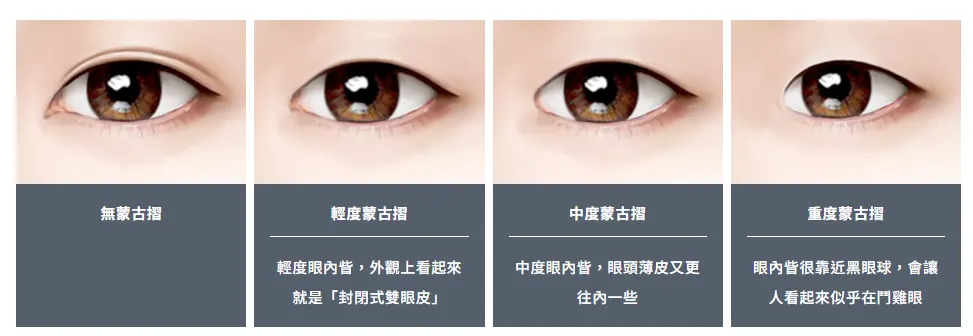
The epicanthal fold is the excess skin at the inner corner of the eye. Academically, it is roughly divided into the following four types:
- Type 1, fully open: no surgical adjustment needed
- Type 2: mild epicanthus, which looks like a “closed double eyelid”
- Type 3: moderate epicanthus, where the thin skin at the inner corner extends further inward
- Type 4: the most severe epicanthal fold, with the inner corner of the eye very close to the iris, which can make a person look cross-eyed
What Is Epicanthoplasty? Can It Improve an Epicanthal Fold?
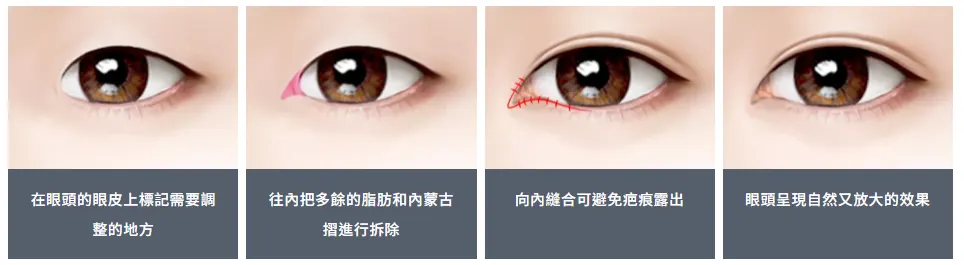
Epicanthoplasty mainly removes the thin skin covering the inner flesh of the eye and pulls the skin apart, making the eye shape longer and softer while reducing the distance between the eyes, which also makes the nose look more prominent visually. By removing excess upper eyelid tissue, the double eyelid no longer hides inside the inner corner, the inner corners of the two eyes move closer toward the nose, the gaze becomes more focused and lively, and the double eyelid looks deeper, with a partial eye-enlarging effect. The incision is made on the inner side of the eye corner, so the scar is hidden in the inner corner, and a few months after surgery it is almost invisible.
Traditional epicanthoplasty mostly involves cutting the skin at the inner corner of the eye and then suturing it directly to hold the corner open, using W-shaped, Z-shaped, or Y-shaped medial canthal incisions. In addition to these three traditional approaches, NAISS CLINIC has newly introduced a Korean-style epicanthoplasty technique, in which a slightly curved horizontal incision is made at the inner corner of the eye and the wound is cleverly hidden within the inner corner. With precise suturing, the scar is less noticeable, and recovery is also shorter than with traditional surgery!
Risks of Epicanthal Fold Surgery
Korean-style scarless epicanthoplasty has been refined, unlike traditional surgery that cuts a wound directly at the inner corner and leaves a more visible scar. Still, any surgery involves incision and suturing, but it is now possible to hide the scar in an inconspicuous spot inside the inner corner. Under normal circumstances, with proper aftercare, a satisfactory recovery can be expected.
As for the eye itself, epicanthoplasty simply opens up the excess skin on the inner side and reveals the corner structures that were originally hidden. The incision overlaps with the skin fold or is hidden in the shadow of the hollow at the corner of the eye, and it does not touch the nerves of the eye, so it will not harm the eye and there is no need to worry excessively.
Korean-Style Scarless Epicanthoplasty vs. Traditional Epicanthoplasty
| Korean-style scarless epicanthoplasty | Traditional epicanthoplasty | |
|---|---|---|
| Surgery time | 30 minutes | 30–60 minutes |
| Recovery | 30 days | 30 days |
| Scarring | Less noticeable scar | Noticeable; may leave a permanent scar |
| Surgical technique | A slightly curved horizontal incision is made at the inner corner of the eye and the wound is cleverly hidden within the inner corner; with precise suturing, the scar is less noticeable | Mostly involves cutting the skin on the inner side of the eye corner and then suturing it directly to hold the corner open |
Aftercare for Epicanthal Fold Surgery
- A small amount of pale, watery blood seeping out right after surgery is normal. Please don't panic.
- Try to keep the wound area away from water for one week after surgery.
- After double eyelid surgery, the outer corner of the eye is covered with skin-colored tape to apply pressure and prevent swelling. Please do not peel it off yourself, as improper force may cause the wound to open.
- Avoid bending over to wash your hair, working with your head down, and strenuous work. Avoid drinking too much fluid before bed; sleep with your pillow propped up to prevent excess swelling and help the swelling go down sooner.
- For diet, avoid spicy or irritating foods, and do not consume tobacco, alcohol, or Chinese herbal supplements and tonics, to prevent renewed swelling or interference with wound healing.
- Avoid straining your eyes as much as possible (for example, getting angry, looking at screens or reading for long periods) and avoid rubbing your eyes. Unnecessary pressure on the eyes can cause the wound to ooze blood, and the resulting swelling can prolong the time it takes to go down.
- Do not wear contact lenses for two weeks, so that removing and inserting them does not interfere with wound healing or increase the chance of infection.
- If you usually wear makeup, do not apply eye makeup before the sutures are removed. Wait at least until the wound has healed and dried before using eye makeup, to avoid pigmentation caused by eye cosmetics.
- Bruising and swelling may still occur after the sutures are removed. Recovery time depends on the individual, so there is no need to worry.
- Eye makeup may only be applied one week after suture removal.
FAQ
Q: Is epicanthoplasty suitable for everyone?
A: People who already have a narrow distance between the eyes are not good candidates for epicanthoplasty, because it would make the eyes sit too close together and ruin the golden proportions of the original eye shape. You can discuss this with your doctor before surgery.
Q: Are there any special considerations for epicanthoplasty in older patients?
A: Older age brings aging-related collagen loss, loose skin, and more fine lines around the eyes, which make surgery more difficult, and of course recovery after surgery is also relatively longer.
How does an epicanthal fold affect the eyes?
An epicanthal fold covers the inner corner of the eye, so when a double eyelid extends to the inner corner, it disappears behind the fold, forming a “closed double eyelid.” As a result, people with epicanthal folds have less noticeable double eyelids, and their eyes look smaller; by contrast, an “open double eyelid” without an epicanthal fold makes the eyes look large and bright and the whole person look more energetic.
Q: What is the relationship between epicanthal folds and eyelids?
A: Epicanthal folds and eyelids actually complement each other. If you want the deep, defined, open double eyelids that Westerners have, the doctor will recommend combining both surgeries. The natural epicanthal fold of East Asians affects the shape and crease line of the double eyelid, so epicanthoplasty makes the double eyelid more noticeable, the contour deeper, and the eye shape more natural.
This article is for general information only. Results vary from person to person; please consult a doctor in person before deciding on any treatment.