Contents
Strong UV exposure makes skin prone to sun spots. It is not only older adults who struggle with spots; anyone can develop sun spots. So can sun spots be removed? Which habits make them worse? This article introduces the 2 main types of spots, how to avoid sun spots in daily life, and, if you already have them, how medical aesthetic treatments can help fade them.
Know the 2 main types of spots
Before learning how to remove sun spots, it helps to know the 2 main types of spots: superficial spots and deep spots. They form in different layers of the skin, so they differ in how hard they are to treat and repair.
1. Superficial spots
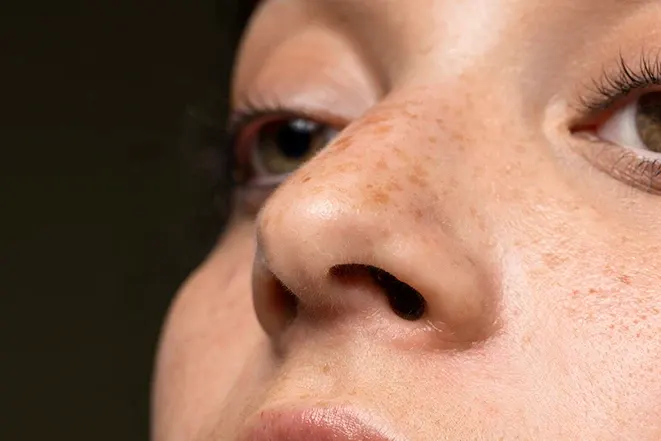
Superficial spots sit in the epidermis and have clear borders, and common types include sun spots, freckles, and age spots. Because the melanin buildup is in a shallower layer, medical lasers, delivery of brightening ingredients, and brightening skincare products can all help lighten or remove superficial spots.
2. Deep spots
Deep spots sit in the dermis and look hazy, with unclear borders, and common types include nevus of Ota and Hori's nevus (cheekbone spots). Because the excess melanin has reached the deeper layers of the skin, lightening with brightening products is limited, so treatment is generally supplemented with medical lasers, which give more noticeable results.
5 main causes of sun spots
1. UV rays cause melanin deposits
Sun spots form mainly because melanocytes in the epidermis are stimulated by UV rays and produce excess melanin.
2. Using photosensitizing brightening ingredients
Some brightening products contain photosensitizing ingredients, such as retinoic acid and arbutin. While these ingredients promote skin renewal, they also make the skin more sensitive to sunlight. This makes it easier for UV rays to damage the skin and cause sun spots, and may even trigger sunburn symptoms such as itching and pain.
3. Lack of antioxidants in daily skincare
Antioxidant skincare ingredients such as vitamin C derivatives, vitamin B3, and peptides help strengthen the skin's defenses and keep UV rays from damaging skin cells and causing pigment deposits. When choosing brightening and spot-fading skincare, check whether the product contains these antioxidants to help sun spots fade gradually and restore a naturally fair complexion.
4. Staying up late and not getting enough sleep
Lack of sleep disrupts the skin's normal repair mechanisms, so when the skin is hit by UV rays it has a harder time starting self-repair. This makes pigment deposits and sun spots more likely to form and speeds up skin aging.
5. Not getting enough antioxidant nutrients
If your diet is usually unbalanced and lacks antioxidant nutrients such as vitamin C and vitamin E, your skin condition may be affected. The skin then has less protection against UV rays, which prompts melanin production and leads to sun spots.

Do you have habits that make sun spots worse?
The following five habits can make skin spots more noticeable. See whether you have any of them.
1. Frequent saunas or hot yoga
When skin is in a high-heat environment (such as spa saunas, heat chambers, hot yoga, or overly stuffy spaces), blood vessels dilate from the heat and are more likely to stimulate pigment cells. This makes melanin, the skin's protective mechanism, easier to produce, leading to pigment buildup and browning, and spots become harder to fade.
2. Not knowing what is in your sunscreen
Among UV rays, UVA has the longest wavelengths. It tans and ages the skin and triggers melanin production and pigment deposits. UV rays span 280-400 nm, so for a sunscreen to meet the broad-spectrum standard for UVA protection, its critical wavelength must reach 370 nm. When buying sunscreen, check whether the label says “Broad Spectrum” (in Chinese or English).
In addition, many sunscreens show UVA protection with stars or PA+ ratings. PA goes up to 4 plus signs, and star ratings come in 4 or 5 stars. The more plus signs or stars, the higher the protection, and the more noticeable the spot-fading effect.
3. Staying up late and keeping irregular hours
According to the National Sleep Foundation in the United States, adults and older adults should sleep 7-9 hours a night, ideally going to bed before midnight, so the body gets enough rest. This helps avoid the long-term chronic hypoxia and immune dysregulation caused by lack of sleep, which in turn lead to excessive free radical production and make spots harder to fade.
4. Not choosing antioxidant ingredients in daily skincare
Using skincare with antioxidant ingredients is also an effective way to fade spots and can even help prevent new spots from forming. Check whether the skincare products you use contain ingredients from the following categories:
In addition, taking suitable antioxidants helps lay a good foundation for the body, defend against free radicals more effectively, and improve the spot-fading effect. Eat plenty of fresh, seasonal fruits and vegetables, and supplement specific nutrients such as vitamin A (beta-carotene), vitamin C, and vitamin E when appropriate.
5. Squeezing pimples and blackheads with your hands
Pimples and blackheads are the skin's response to infection and inflammation. If they are squeezed the wrong way, melanin deposits can easily form once the inflammation fades, which may leave acne marks of varying depth on the face, and these marks can make the skin look spotted. So if you have fairly severe acne, don't force it out. The first step is to see a professional dermatologist, which spares your skin unnecessary strain.
Learn more:
Oily skin, blackheads, and breakouts? Proper skincare tips to improve skin problems
Say goodbye to acne marks and dull pores: how mandelic acid can transform your skin

4 ways to fade spots at a glance
With age, flat sun spots can become raised age spots as keratin builds up, and they become harder to treat. Preventing them early and caring for your skin early is therefore the key to removing sun spots. Here are 4 ways to fade spots:
1. Use sun protection consistently
Good sun protection not only prevents photoaging of the skin but also preserves its ability to repair itself, keeping sun spots from getting darker. We recommend choosing physical sun protection first, such as long sleeves, long pants, and hats, or sunscreens whose main ingredients are zinc oxide (ZnO) and titanium dioxide (TiO2). These resist UV rays through physical principles such as reflection, refraction, or scattering, and are less likely to irritate the skin than chemical sunscreens.
2. Gentle brightening and spot-fading skincare
Daily brightening and spot-fading skincare can speed up melanin turnover. We recommend products with gentle ingredients such as tranexamic acid, ellagic acid, vitamin C derivatives, and niacinamide (vitamin B3), which inhibit melanin activation and improve skin radiance, so brightening and spot fading is more reassuring and gentle on the skin.
In addition, medical skin booster injections can also inhibit melanin formation and prevent pigment spots, improving uneven skin tone and brightening the complexion. The formulas are diverse and can be customized to target all kinds of skin concerns. They combine multiple essence ingredients in tailored ratios, going deep into the dermis to condition the skin base and reshape firm, supple, youthful skin for a flawless complexion.
Learn more:
Why Korean girls love the skin booster gun: does it really work? Everything you need to know
3. Improve your diet and lifestyle habits
Good daily habits help keep skin healthy. In your diet, eat more foods rich in vitamin C and vitamin E, such as guava, kiwi, avocado, and broccoli, to strengthen your skin's defenses from the inside out. For lifestyle, we recommend getting enough sleep and moderate exercise to help the body maintain good metabolism and bring back an even, radiant complexion.
4. Medical lasers
Laser spot removal is a common way to fade spots in aesthetic medicine, including picosecond lasers, intense pulsed light, Q-switched lasers, and fractional lasers. Results are fast and noticeable. We recommend the third-generation StarWalker PQX, which effectively helps improve sun spots:
Learn more:
A laser without rebound darkening! How StarWalker PQX improves skin condition
This article is for general information only. Results vary from person to person; please consult a doctor in person before deciding on any treatment.