Contents
Facelifts are very common, and they come in three forms: radiofrequency, ultrasound, and surgical facelifts. There are non-invasive maintenance options as well as minimally invasive surgeries with hidden scars, so what are the differences and how should you choose? Today we have put together the differences among the three approaches and an analysis of facelift surgery. Let's see whether a "facelift" can restore youthful skin easily and quickly!
Telling Your Facial Lines Apart: Static vs. Dynamic Wrinkles
Telling facial lines apart is actually simple! Lines that appear when your expression changes noticeably, such as when you laugh or scrunch your face, are called "dynamic wrinkles," while wrinkles you can still see when your face is expressionless are called "static wrinkles."
Dynamic wrinkles: lines produced when the facial expression muscles contract, such as forehead lines, frown lines, and crow's feet.
1. Forehead lines: horizontal lines produced by the frontalis muscle.
2. Frown lines: lines that form when you furrow your brow, also known as glabellar lines.
3. Crow's feet: lines produced when the orbicularis oculi muscle around the eyes contracts as you laugh or blink.
How to improve them: Botulinum toxin injections can be used to treat wrinkles caused by excessive muscle contraction, moderately relaxing the muscle and reducing wrinkle formation.
Static wrinkles: lines that are still clearly visible when the facial muscles are not specifically contracting.
1. Widespread lines caused by skin aging, loosening, or sagging, such as under-eye fine lines and neck lines.
2. Dynamic wrinkles that, through skin aging or loss of elasticity, gradually become static wrinkles over time, such as forehead lines and nasolabial folds.
How to improve them:
1. Strengthen skin hydration and sun protection, or use lasers to increase dermal thickness.
2. For wrinkles caused by loss of subcutaneous fat or soft tissue, or by sagging, fill with your own fat or synthetic fillers (such as hyaluronic acid) to add soft tissue volume and reduce wrinkles.
3. Deep and widespread wrinkles can be treated with radiofrequency or ultrasound to tighten the subcutaneous tissue. Severe wrinkles can be improved with facelift surgery.
Radiofrequency Lifting vs. Ultrasound Lifting vs. Facelift Surgery
Radiofrequency and ultrasound treatments are both "non-invasive" ways of treating skin aging, while "facelift surgery" requires cutting the skin, trimming it, and pulling it tight.
Radiofrequency and ultrasound lifting work by heating the skin tissue to tighten it and promote collagen production, which can also make the skin plumper and firmer. The differences between the two are as follows:
Ultrasound Lifting (Ultrasound Skin Tightening)
It uses focused ultrasound to gather thermal energy of 65-70°C into countless coagulation points, heating from the inside out and promoting collagen production so that facial contours become more defined.
Radiofrequency Lifting (Radiofrequency Skin Tightening)
It uses volumetric heating, in which a high-frequency current vibrating at least about 6 million times per second oscillates in the deep skin to generate thermal energy of 55-65°C and heats the deep subcutaneous tissue "from the outside in," tightening the skin overall, restoring its original elasticity, and stimulating collagen production.
And What Is "Facelift Surgery"?
It lifts loose, sagging muscle, fat, and subcutaneous soft tissue to the ideal position, with noticeable and long-lasting results. A facelift separates loose skin from the fascia through incisions, pulls the sagging skin taut and back into place, and, as needed, removes excess skin, improving laxity and increasing skin firmness. Depending on incision size and location and the fixation method, it is divided into traditional facelift surgery and HD minimally invasive endoscopic facelift surgery.
Analysis of Facelift Surgery Methods
Surgical methods are divided into "multi-layer facelift surgery" and "minimally invasive endoscopic facelift surgery", each suited to different groups and with different pros and cons. A summary table is below for reference:
| Multi-layer facelift surgery | Minimally invasive endoscopic facelift surgery | |
|---|---|---|
| Best for | People with severely loose, sagging skin | Mature patients aged 40-60 with laxity |
| Surgical materials | Sutures / bone screws | Five-prong / eight-prong fixation tacks |
| Surgery time | 3-4 hours | 2-3 hours |
| Recovery time | About 14-21 days | About 14 days |
| How long it lasts | 8-10 years | 5-8 years |
| Incision location | A horizontal incision along the forehead hairline, or vertical incisions along the temples and from below the ears to behind the ears. | 3-5 small incisions on the forehead, or incisions below and behind the ears. |
| Advantages | Wide lifting area and greater lift; results last longer | Small incisions, almost no visible scar, short recovery, many fixation points, and no suture removal |
| Disadvantages | Larger incisions, longer recovery, fewer fixation points, and a return visit for suture removal | High technical demands, shorter-lasting results, and limited suitable candidates |
Which Areas Can a Facelift Improve?
Surgery areas fall into two categories: face and body.
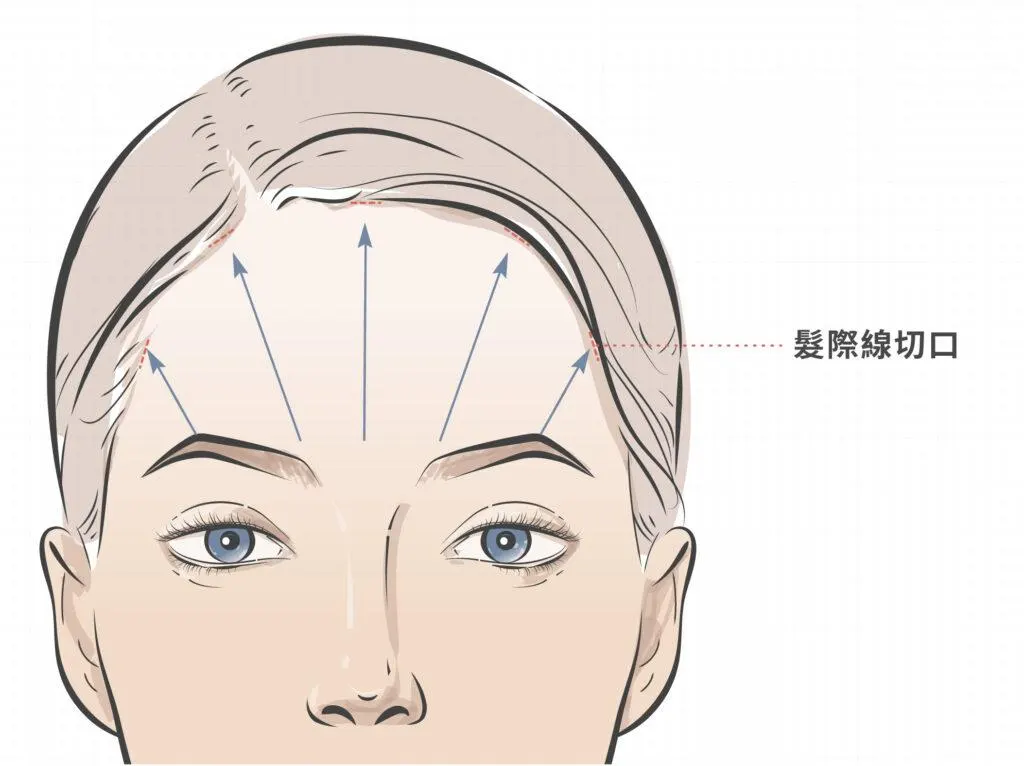
"Forehead lift surgery," also called upper-face lift surgery, can improve forehead lines, glabellar lines, drooping brows and eyelids, brows weighing on the eyes, fine lines around the eyes, and other upper-face laxity. The incisions are small and hidden at the hairline, leaving almost no visible scar, and surgery time and recovery are relatively short.
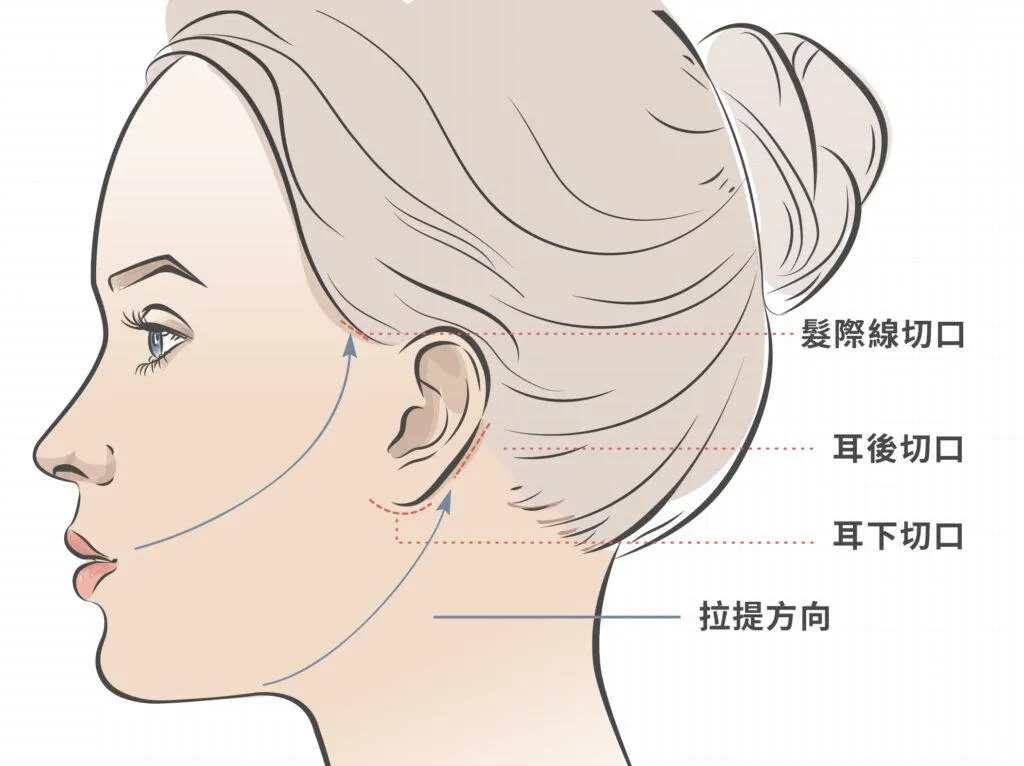
"Mid and lower face lift surgery" can improve sagging cheeks, nasolabial folds, marionette lines, an undefined jawline, neck laxity (turkey neck), and other mid and lower face laxity, with the incisions hidden at the hairline and below and behind the ears, so the scars are hard to notice.
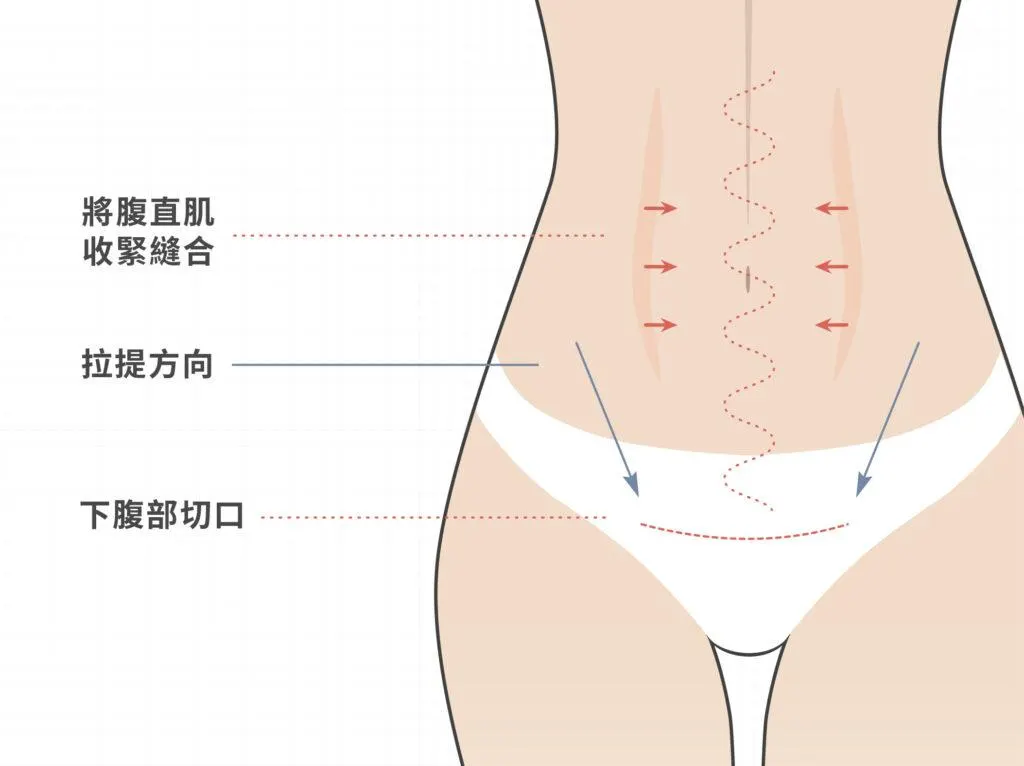
"Abdominal lift surgery (tummy tuck)" makes an incision in the lower abdomen and pulls loose skin and abdominal lines down flat, treating abdominal laxity such as excess skin (from major weight loss), stretch marks, and diastasis recti.
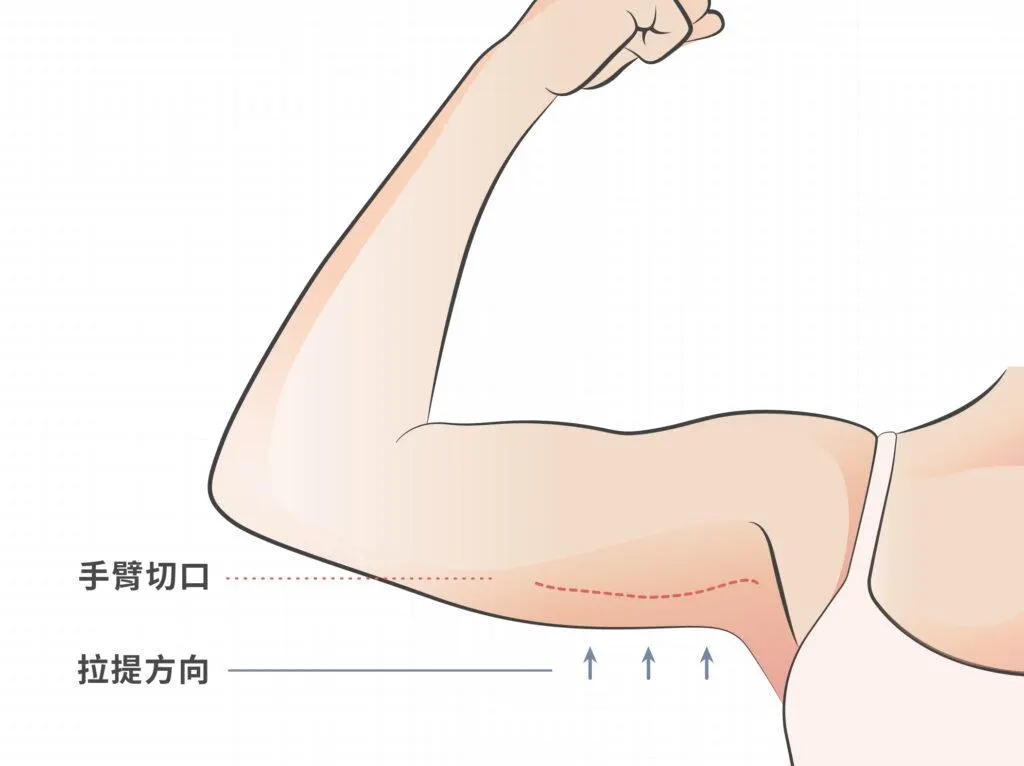
"Arm lift surgery": an arm lift is a procedure for "bat wings", the loose skin left after rapid weight loss or liposuction. The incision runs from the armpit to the inner arm, and the wound is sutured after the excess is removed. Surgery takes about 2 hours, and if there is too much fat, liposuction can be done at the same time.
| Upper-face lift | Mid and lower face lift | Abdominal lift | |
|---|---|---|---|
| Improves | Laxity of the forehead, around the eyes, and nearby areas | Laxity of the cheeks, neck, and other mid and lower face areas | Laxity after major weight loss or childbirth, diastasis recti, and similar areas |
| Incision location | 3-5 small incisions at the hairline | Incisions at the hairline, below the ears, and behind the ears | Lower abdominal crease or C-section scar |
| Surgical materials | Five-prong tacks | Five-prong and eight-prong tacks | Sutures |
| Surgery time | About 2-3 hours | About 2-3 hours | About 3-4 hours |
| Recovery time | About 14 days | About 14 days | About 1 month |
5 Major Complications of Facelift Surgery
1. Subcutaneous hematoma: A hematoma can occur when the epinephrine in the local anesthetic is absorbed and causes rebound high blood pressure.
2. Facial nerve injury: The facial nerve lies beneath the fascia and can be injured if the surgery is not careful. It is also one of the most serious complications of facelift surgery.
3. Poor skin flap healing: The main cause is ischemic necrosis. Because facelift techniques have changed, it is now mostly related to the patient's skin quality, peripheral circulation, and aftercare. We recommend a thorough consultation before surgery and discussing any concerns with your doctor.
4. Poor hair growth: This is related to the incision location, flap thickness, and suture tension. Poor hair growth and hair loss can occur near the wound, and we suggest discussing with your doctor whether the surgical site should be kept away from the hairline.
5. Hypertrophic scarring: Patients prone to keloids or scarring should discuss with their doctor whether to hide the scars in less visible places.
This article is for general information only. Results vary from person to person; please consult a doctor in person before deciding on any treatment.