Contents
What is VASER liposuction, which everyone keeps talking about? Is it really that good? How is it different from traditional liposuction? VASER liposuction is so popular because of its many advantages, such as a shorter recovery period, less unevenness, less skin laxity, and less tissue damage, and more. Today we introduce VASER liposuction to give you one more option for liposuction surgery, so you can sculpt your ideal curves through surgery! Mermaid lines and abs lines are no longer just a dream!
Getting to Know VASER Liposuction
VASER liposuction is the latest-generation VASER “ultrasonic liposuction” device, invented by Sound Surgical Technologies in the US in 2000, and the only liposuction machine on the market with fat selectivity. VASER liposuction uses a patented titanium probe to release sound waves at a fixed frequency (36,000 Hz), which can emulsify fat in both the shallow and the superficial layers.
Under the patented “fat selectivity” technology, sound waves enter the tissue and cause resonance, and the emulsified fat becomes very fine and smooth, so it can be suctioned out easily. At the same time it can sculpt superficial skin contours, leaving the skin firmer after surgery.
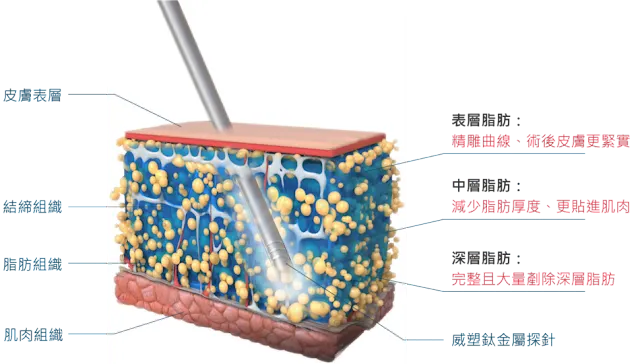
And “emulsification” does not damage important nerves and blood vessels or the connective tissue between skin and muscle, which greatly reduces swelling and discomfort after surgery. In addition, fat cells remain structurally intact after emulsification, which increases the survival rate of fat after fat transfer.
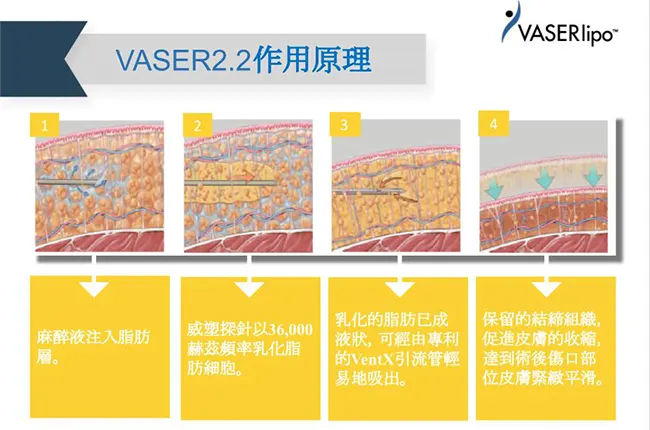
Fat emulsification: breaks the fat apart more evenly. During suction, it keeps blood loss to a minimum, and the extracted fat is relatively pure. With less bleeding, liposuction goes more smoothly.
VASER Liposuction vs. Other Liposuction Methods
There are many liposuction methods, but do you really understand them? Liposuction falls into “traditional liposuction,” “water-jet liposuction,” “laser liposuction,” and “ultrasonic liposuction.” Let's take a look at these four methods!
How traditional liposuction works:
First, tumescent solution is injected and left to sit for a while. Then, using negative pressure, a thin tube (about 3–4 mm) is inserted into the area to be treated, the fat is broken up by a tearing action, and once broken up it is suctioned out by hand and by vacuum!
| Pros | Shorter surgery time |
|---|---|
| Cons | Because the fat is torn apart, bleeding is relatively high, and the repeated suction motion also causes greater damage to the tissue. |
A little background: tumescent solution is used to expand the tissue so fat cells separate more easily.
How water-jet liposuction works:
The tumescent solution stage at the start is much the same as in traditional liposuction, but the hallmark of water-jet liposuction is that it uses “more water” at higher pressure so the fat tissue can be flushed apart more thoroughly and evenly.
| Pros | Water is used to break up the fat cells, so no heat is generated and the fat suffers less damage. |
|---|---|
| Cons | Because the fat is torn apart, bleeding is relatively high; more water is needed, so swelling after surgery lasts longer and is more pronounced, and recovery takes longer. |
How laser liposuction works:
It uses light shock waves to dissolve the fat, but it does more damage to the fat. And laser liposuction can treat only a small area at a time, so large-area liposuction takes longer to complete, and of course anesthesia time is longer too!
How ultrasonic liposuction works:
The most talked-about type of ultrasonic liposuction is “VASER liposuction,” which uses gentle and precise ultrasound (36,000 Hz) to perform “emulsification” on the fat, so the emulsification process during liposuction can be gentler and safer.
VASER differs from earlier ultrasound machines in having an added “resonance effect,” which is selective toward fat; for the surrounding tissue, such as nerves or blood vessels, the selective damage is reduced. That is why VASER liposuction has an extra step, “emulsification,” which turns stubborn fat into an emulsion so it is easier to suction out. (Even in second or later liposuction surgeries, tissue damage and blood loss can be effectively reduced.)
How Is Liposuction Priced? How Can You Avoid Complications? A Complete Guide in One Place!
VASER Liposuction vs. Other Liposuction Methods
VASER liposuction is characterized by less blood loss and less tissue damage, so the recovery period after surgery is relatively short, and swelling is less severe. Because of emulsification, the doctor can also work on more superficial fat, suctioning it out more effectively for contour sculpting. Skin firmness is also better, but emulsification does make the surgery a little longer (on average 10–15 extra minutes per area).
P.S. If the doctor is not familiar with the VASER machine, burns are still possible, so we recommend choosing an experienced, well-reviewed doctor so that fat can be removed more safely and efficiently!
Fat emulsification: dissolves fat cells into a fluid
Will the Fat Come Back After Liposuction?
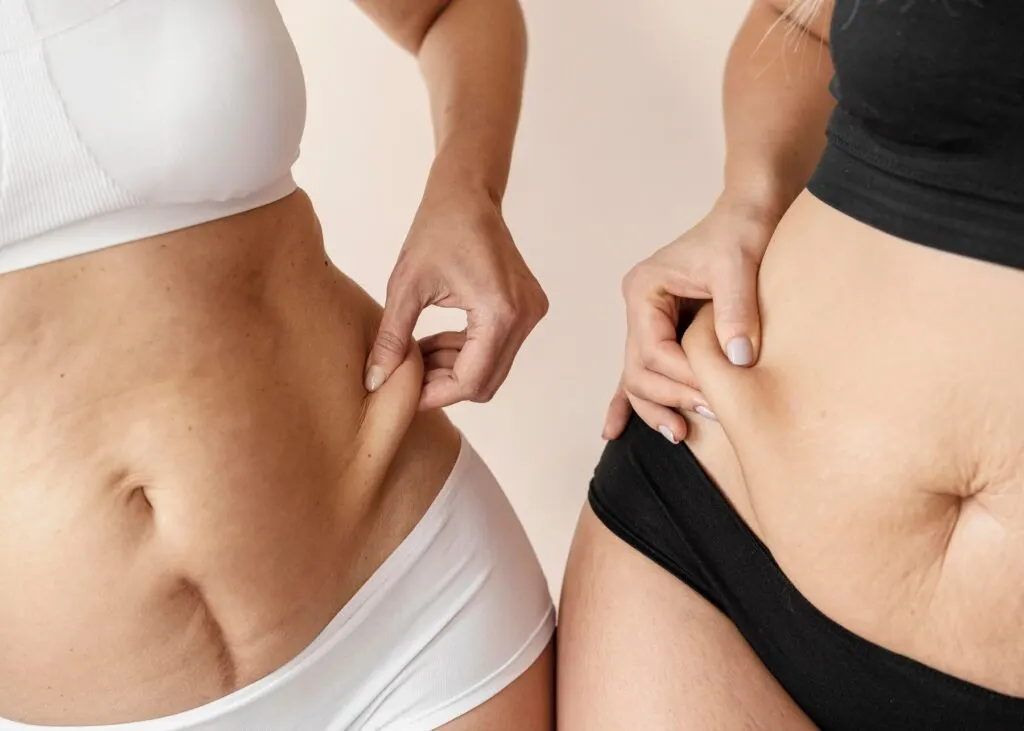
The biggest worry about liposuction is, of course: will the weight come back? In principle, once fat cells have been removed they do not grow back, but depending on everyday eating habits, individual fat cells can still grow larger or smaller. So if you don't manage your diet, the remaining fat cells will quietly grow larger and you can regain weight.
Therefore, liposuction is not a weight-loss surgery: its purpose is to sculpt areas that are hard to slim down through diet and exercise alone. A healthy figure still requires “a balanced diet and appropriate exercise” to maintain a perfect shape.
Liposuction Cost and What Affects the Price
Liposuction pricing depends on the “procedure time” and the “size of the area treated.”
For example:
Circumferential thigh liposuction price: traditional liposuction about NT$150,000–180,000, water-jet liposuction about NT$160,000–200,000, VASER liposuction about NT$180,000–200,000
Circumferential abdomen liposuction price: traditional liposuction about NT$100,000–150,000, water-jet liposuction about NT$140,000–200,000, VASER liposuction about NT$180,000–250,000
Arm liposuction price: traditional liposuction about NT$50,000–100,000, water-jet liposuction about NT$90,000–120,000, VASER liposuction about NT$100,000–150,000
Accessory breast liposuction price: traditional liposuction about NT$80,000–100,000, water-jet liposuction about NT$100,000–120,000, VASER liposuction about NT$100,000–150,000
Double chin liposuction price: traditional liposuction about NT$40,000–60,000, water-jet liposuction about NT$60,000–100,000, VASER liposuction about NT$80,000–120,000
2023 Liposuction Costs Revealed! Prices for Every Body Area
Recovery and Aftercare
Soreness, swelling, and bruising in the treated areas are normal after surgery. If the lower body was treated, elevate your lower limbs as much as possible while sleeping to help tissue fluid drain and reduce swelling.

Other ways to speed up recovery from liposuction:
1. Wear compression garments and shapewear pants, which help reshape the fat tissue and even out the figure. They compress the treated area, effectively reducing swelling after surgery and increasing comfort, and they reduce the gap between skin and fat after liposuction, which lessens skin laxity.
Recommendation: Wear them all day for 2–4 weeks after surgery; after that, depending on your situation, wear them during the day and take them off at night for 1–2 months.
2. Appropriate massage and physical therapy improve skin smoothness and reduce swelling.
3. Take vitamins and Q10 to speed up the body's ability to repair itself.
4. Avoid strenuous exercise and lifting heavy objects, which can interfere with wound healing.
This article is for general information only. Results vary from person to person; please consult a doctor in person before deciding on any treatment.