Contents
You've heard of radiofrequency and ultrasound, but have you heard of ONDA microwave? Not the microwave at 7-Eleven, but ONDA! Besides tackling sagging in the face and neck, ONDA can also be used to eliminate fat, fighting double chins while lifting the jawline. It also uses ultra-high-frequency microwaves that deliver heat energy directly to fat cells. This article explains what ONDA is and who it suits, and finally how it differs from RF and ultrasound treatments!
4 Common Types of Facial and Neck Sagging
Skeletal type: bone and tooth structure
A receding facial bone structure causes facial sagging (tooth structure is also one contributing factor)
Aging type: collagen loss
Collagen loss from aging and photoaging leaves the cheeks without elastic support, so they sag. This is the most common cause of facial and neck sagging
Fatty type: chubby face / baby fat
Related to the distribution and amount of fat. Some people are not old but have sagging cheek skin, possibly because the facial fat has aged and loosened
Edema type: metabolism
Often appears in the morning or after late nights, and is related to body metabolism and blood circulation (including factors such as lifestyle, pregnancy, medication, and endocrine imbalance). Edema-type sagging is often accompanied by swelling and discomfort, and the skin also lacks elasticity
Saviors for Fatty-Type Double Chins! Lipolysis Injections vs. Chin Liposuction for a Firm Jawline
What Is ONDA Microwave? How Does It Work?
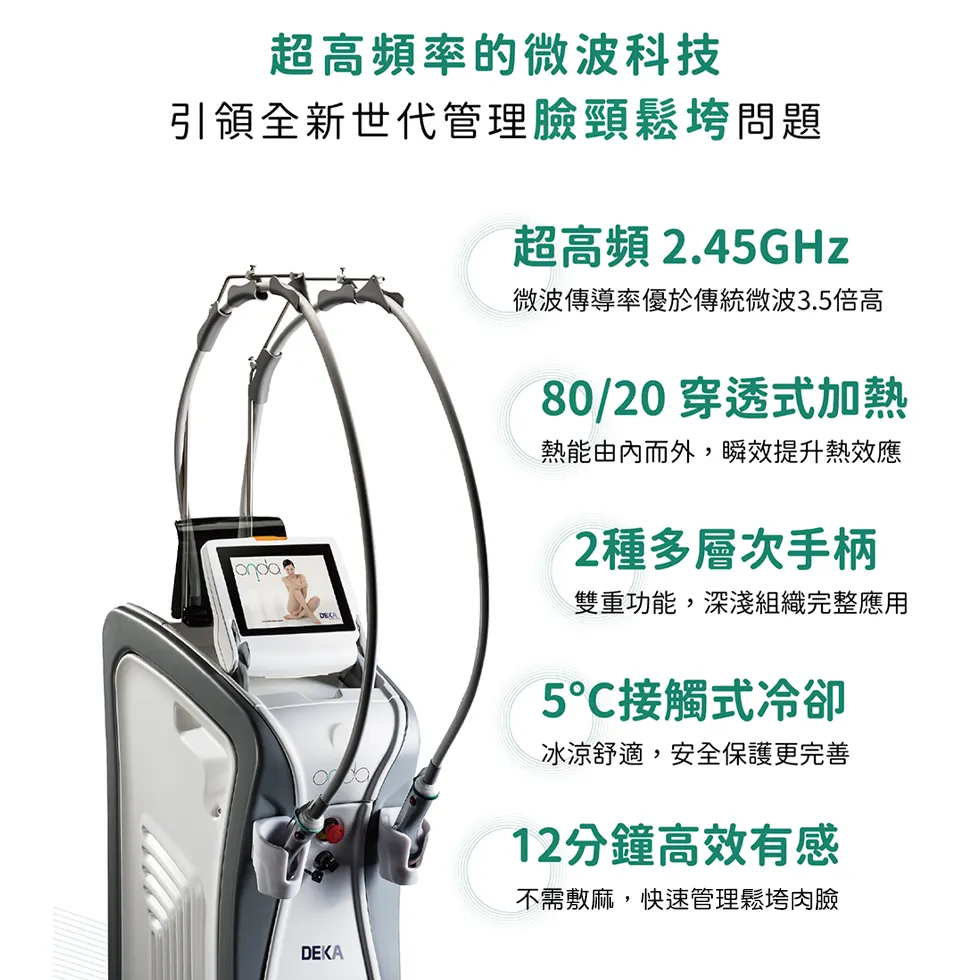
ONDA comes from Italy and uses 2.45 GHz ultra-high-frequency microwaves with 80/20 penetrating heating, passing directly through the epidermis and dermis to heat the fat layer. It has 2 applicators that can act on deeper and shallower subcutaneous tissue. What sets ONDA apart from traditional RF and ultrasound devices is that ONDA heats from the inside out, starting in the fat layer and spreading heat to the dermis. ONDA's applicators also have a cooling system that protects the epidermis and dermis, reducing unnecessary heat, effectively heating the deep layers, and improving comfort. A single session takes only 12-15 minutes, with no numbing cream, no wounds, and no downtime.
Is a 2.45 GHz frequency really strong? What are the benefits?
- Radiofrequency: 6 MHz
- Traditional microwave frequency: 40 MHz
- ONDA microwave frequency: 2.45 GHz = 2450 MHz
The higher the frequency, the lower the impedance it meets, which means it can pass straight through the epidermis and dermis and heat fat directly
What is 80/20 penetrating heating?
- 80%: Energy is absorbed first by the fat layer, and the temperature rises quickly to 42/43°C, causing heat damage to the fat cell membranes and leading to fat cell apoptosis and a reduction in fat
- 20%: Energy acts on the epidermis and dermis, using heat diffusion to firm the skin
2 Handpieces for Different Areas
| Shallow applicator (superficial fat) | Pocket applicator (collagen) | |
|---|---|---|
| Heating depth | Fat layer 0.7 cm beneath the skin | Dermis 0.3 cm beneath the skin |
| Principle | Builds up heat in the facial dermis and fat areas, with energy split evenly at 50% each | Concentrates 80% of the heat in the reticular dermis, causing collagen to contract and deform and then regenerate |
| Suitable areas | Cellulite, skin laxity, double chin | Facial and neck sagging, nasolabial folds, marionette lines, submandibular gland aging (jowls) |
Both applicators use the exclusive, patented Coolwaves® technology, which selectively penetrates and acts on fat tissue without overheating the dermis, and the applicator provides 5°C cooling protection to the skin surface, ensuring comfort while reducing side effects after the procedure
ONDA Microwave vs. Traditional Microwave
| ONDA microwave | Traditional microwave | |
|---|---|---|
| Heating method | Penetrating heating | Gradient heating |
| Target layer | 20% epidermis/dermis, 80% fat layer | 70% epidermis/dermis, 30% fat layer |
| Principle | From the inside out 80% of the energy is absorbed first by fat cells, so deep layers heat up quickly. 20% of the energy is absorbed by the dermis, which firms the skin. The applicator's cooling system prevents burns to the epidermis | From the outside in Energy spreads downward from the epidermis, and the main heat is absorbed first by the epidermis and dermis, which easily weakens the heating of fat cells in the deep layers. To avoid burns, the energy cannot build up or be increased |
ONDA vs. Thermage FLX vs. Ultraformer MPT
ONDA mainly heats the fat layer, improving localized fat and cellulite; radiofrequency heats volumetrically from the skin surface, mainly improving skin laxity and fine lines, with limited effect on the fat layer; ultrasound heats from the inside out with point-by-point lifting, mainly improving sagging contours.
ONDA complements RF and ultrasound well and solves the fat-layer problems they cannot improve; usually one session is already effective
| ONDA | Thermage FLX | Ultraformer MPT | |
|---|---|---|---|
| Heating method | Inside-out penetrating heating | Outside-in 3D volumetric heating | Focused point-by-point heating |
| Effect | Firming, lifting, fat reduction | Skin tightening and wrinkle reduction | Lifting and sculpting |
| Indications / areas | Chubby face, double chin, turkey neck, cellulite, postpartum abdominal laxity, localized body fat | Facial lifting and firming, fine lines around the eyes, sagging, fine lines, cellulite, turkey neck, body skin laxity | Facial lifting, large areas of body laxity, fine lines and neck lines, double chin, jowls, waist fat, jawline |
| Treatment depth | 0-7mm | 0-4.5mm | 1.5-13.0mm |
| Number of applicators | 2 | 4 | 10 |
| Treatment layer | Fat layer and above | Dermis, fascia layer | Dermis, fascia layer |
| Session time | About 12-15 minutes | About 45-60 minutes | About 30-60 minutes |
| Pain level | * | ***** | *** |
| Duration | 6-8 weeks | 18-24 months | 12-18 months |
Who Is ONDA Suitable For?
- Chubby face
- Double chin
- Turkey neck
- Cellulite
- Postpartum abdominal laxity
- Localized body fat
Precautions for ONDA
Before treatment
- If the treatment area has had lasers, injectable fillers, surgery, or similar treatments, tell your doctor first
- Not recommended for people who are pregnant, breastfeeding, have a pacemaker or implantable cardioverter-defibrillator, or have an acute skin infection or inflammation in the treatment area
- For 1 week before treatment, avoid irritating skincare products (such as acids, whitening products, and exfoliants)
- For 1 week before treatment, avoid sun exposure, hot spring baths, hot-air saunas, and other high-temperature places
- If the skin is sunburned or peeling, wait until it has recovered before treatment
After treatment
- About 15-20 minutes after treatment, redness and the warm sensation fade. Only a small number of people have slight swelling, which disappears after about 1-2 days
- After treatment, keep the skin moisturized and protected from the sun, and drink plenty of fluids
- For 1 week, stop using more irritating products that contain alcohol, whitening agents, acids, exfoliants, and similar ingredients
- For 1 week, avoid swimming pools, the beach, and high-temperature environments (hot springs, hot-air saunas, steam rooms, etc.)
FAQ
Does the treatment hurt?
ONDA needs no numbing cream and leaves no wounds or downtime, and it has a contact cooling system that effectively lowers the chance of heat damage and pain in the epidermis, so during the procedure you will only feel localized warmth
How long does the treatment take? How often can it be done? How soon will I see results?
Not including face washing and makeup removal before treatment, each session takes about 12-15 minutes. The number of sessions varies with the treated area and degree of laxity. You can notice a difference after just 1 session, but a course of about 3-5 sessions is usually recommended, with 2-3 weeks between sessions. You can actually feel results right after the treatment, and they become more obvious at around 2-3 weeks.
How long do the results last?
- Fat reduction: once fat is destroyed, it disappears through metabolism, but if you overeat, it can still come back!
- Collagen: can last about 6-8 weeks, depending on personal constitution, lifestyle habits, and more
This article is for general information only. Results vary from person to person; please consult a doctor in person before deciding on any treatment.