Contents
They say people of every gender care about the shape of their legs. Is that true? According to market surveys, many men do pay special attention to women with nicely shaped legs, and women, of course, need no explanation: they surely want legs with beautiful, straight lines, so DIY calf slimming is bound to come up! Leg raises, massage, and all kinds of calf-slimming tricks are all on the table. But did you know these methods could very well backfire? If done incorrectly, your legs could end up getting thicker and thicker! This article therefore rounds up several myths about “slimming calves,” along with the types of “big calves” and ways to improve them.
DIY Fixes for Big Calves (Exercise)
Many YouTubers online share at-home calf-slimming exercises, saying a simple 8-10 minutes is enough to slim your calves. However, if these moves are not done correctly, they may well backfire! Doctors have also analyzed several common calf-slimming exercises from a medical perspective:
1. Everyone is born with different calf muscles. Some people naturally have slim legs, and some naturally have thick calves. Natural traits are hard to change through exercise later in life, and the only ways to change them are to “build them up so they get thicker” or to “use them less so they get thinner”, so common moves such as “calf raises” may make your calves even thicker!
2. Does stretching really slim you down? Doctors point out that muscles are lengthened when you stretch, so they look thinner visually. But once the muscle relaxes, it gradually returns to its original shape, just like the idea of stretching to relax after a workout.
3. The reason for thick calves is “fat,” not water retention or muscle, so the only thing you need to do to slim your calves is “reduce fat”. When the calories you take in are less than the calories you burn, fat across the whole body decreases, and calf fat decreases along with it!
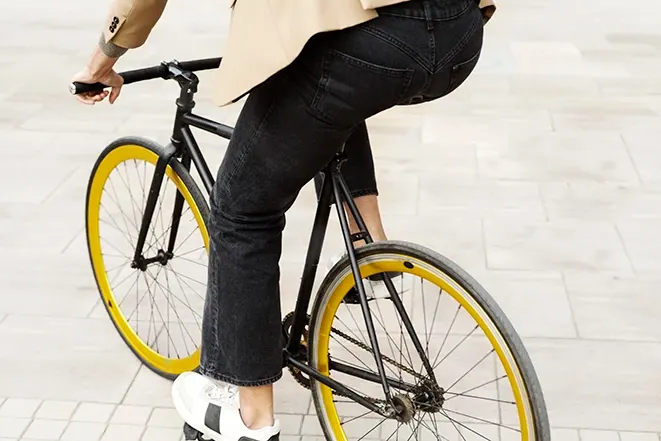
4. Recommended exercises for burning fat: running, cycling, and swimming to boost fat burning. Once fat is burned down to a certain level, you will gradually see your muscle lines! (If you like more defined lines, you can also train and sculpt them later on.)
That said, many people have successfully slimmed down by following the methods YouTubers share, so different methods suit different people. If you have the time, you can also try them out at home!
Types of Big Calves
Muscle type: The main cause of big calves here is “muscle.”
Fat type: Fat accumulates in the calves, causing a large calf circumference and a bulky appearance, and the legs look pale, fleshy, watery, and plump.
Water-retention type: Poor circulation in the lower legs causes swelling from water retention in the calves.
P.S. A combination of the fat type and the muscle type is also possible!
Can Exercise Make Legs Bulkier? Does Stretching Really Help?
Everyone says cycling and exercise only make your legs look bigger, and it is even worse if you do not have a habit of stretching after workouts. There is also a claim that stretching can make legs slimmer! Is that really true? It depends on your type of big calves:
If you have muscle-type big calves
The muscle has already been trained into small balls or knots, and if you rely only on stretching or exercise to change the shape of the calf, the effect is quite limited. The reason is that the muscle has already developed, and the purpose of stretching is to “increase the range in which the muscle can be trained and grow,” so the result may be only a very subtle change, and once the muscle has formed knots, it can no longer be eliminated by stretching or massage alone.
If you have fat-type big calves
In that case, using “local stretching and massage” is highly recommended to increase metabolism. It may help eliminate “some” of the calf fat and make the calves look slimmer.
P.S. Editor’s reminder: the improvement from stretching is limited, and since everyone’s natural traits differ, the results are not absolute and are for reference only.
Doctors also recommend these ways to prevent big calves: after exercise, gently massage and stretch the muscles to keep any one area from bulking up excessively, and avoid over-stimulating the calves, such as through excessive running and jumping or wearing high heels. You can try these methods, but if they do not solve your concern, or you do not want to spend the time, you can choose the options introduced next!
Advantages of Botox for Calves
Botulinum toxin works by “blocking the connection between nerves and muscles.” When a muscle can no longer be directed by the nerves, it cannot perform its function, so the muscle gradually atrophies and gets smaller, and this can improve so-called “muscle-type big calves”.
One thing to note here: big calves do not automatically mean botulinum toxin treatment. Before treatment, be sure to find out what type of big calves you have!
Which Botulinum Toxin Brand Is Best? Is Botox Really No. 1? Effects Compared Side by Side
Aftereffects of Botox for Calves
The most common aftereffect is “temporary bruising”. Because the treatment is done by injection, bruising may appear at the needle sites, but it does not affect your health or daily life, so there is no need to worry too much. It usually fades gradually in about a week.
How Many Sessions Until You See Results? How Often?
The effect of Botox for calves gradually appears in about 1.5-2 months, and the recommended course is “2-3 consecutive sessions at 3-6 month intervals”. Although botulinum toxin is metabolized by the body over time, as long as you do not keep training the muscle, the results are basically stable after 2-3 sessions. However, if you exercise more or train more often after the course, the muscle may gradually grow back!
Why Is Botox From the US So Popular? A Guide
Is Calf Liposuction Recommended?
The methods mentioned above mainly improve “muscle-type big calves.” So what about “fat-type big calves”? Basically, we recommend removing the fat. In addition, a nerve-blocking surgery can be done on the gastrocnemius muscle, which will also be introduced next!
Lipolysis injection
Local injection of lipolysis injections can eliminate fat, but how long the results last depends heavily on personal care and lifestyle habits. This approach therefore suits people with a limited budget, those new to aesthetic medicine, people who are diligent with upkeep, and those whose big calves are not very severe.
Can Lipolysis Injections Fail? Causes, Contraindications and Post-Treatment Massage in One Article
Calf liposuction
Liposuction is an invasive treatment, so the choice of liposuction method, the doctor’s skill, the doctor’s experience, and the placement of the incision points are all critical.
Among liposuction methods, “VASER liposuction” is the most popular and also the safest device today. It uses a titanium probe, the metal most compatible with the human body, to release ultrasound that breaks down fat cells, without damaging the surrounding blood vessels, nerves, and connective tissue, so it can effectively reduce bleeding, bruising, and pain, and you do not need to worry about loose skin after surgery! Aftercare for calf surgery is also very simple: just wear “compression stockings” diligently as your doctor instructs!
Gastrocnemius surgery
As mentioned earlier, the main muscle group behind big calves is the “gastrocnemius,” so of course we can work on this muscle too! The gastrocnemius is the outermost muscle of the calf. In this surgery, the nerve to the gastrocnemius is cut so that it can no longer function, and over time “use it or lose it” causes the muscle to atrophy, achieving a slimmer calf.
But! This surgery is irreversible, and a possible side effect is compensatory muscle hypertrophy (with one muscle missing from the team, the other muscles have to work harder to move the leg, which makes them grow bigger), so be sure to discuss it with your doctor and get an evaluation before surgery!
This article is for general information only. Results vary from person to person; please consult a doctor in person before deciding on any treatment.