Contents
You can lift your face without surgery and without spending a fortune! Even the small, V-shaped face you want can be improved this way. Beyond basic skin care and device massage, there is also the option of a “facial thread lift” that can quietly make you look better in a single day. What is a facial thread lift, and what does it do? Does it hurt? How long does it last, and what should you watch out for? This article walks through the details.
What Is a Facial Thread Lift, and What Does It Do?
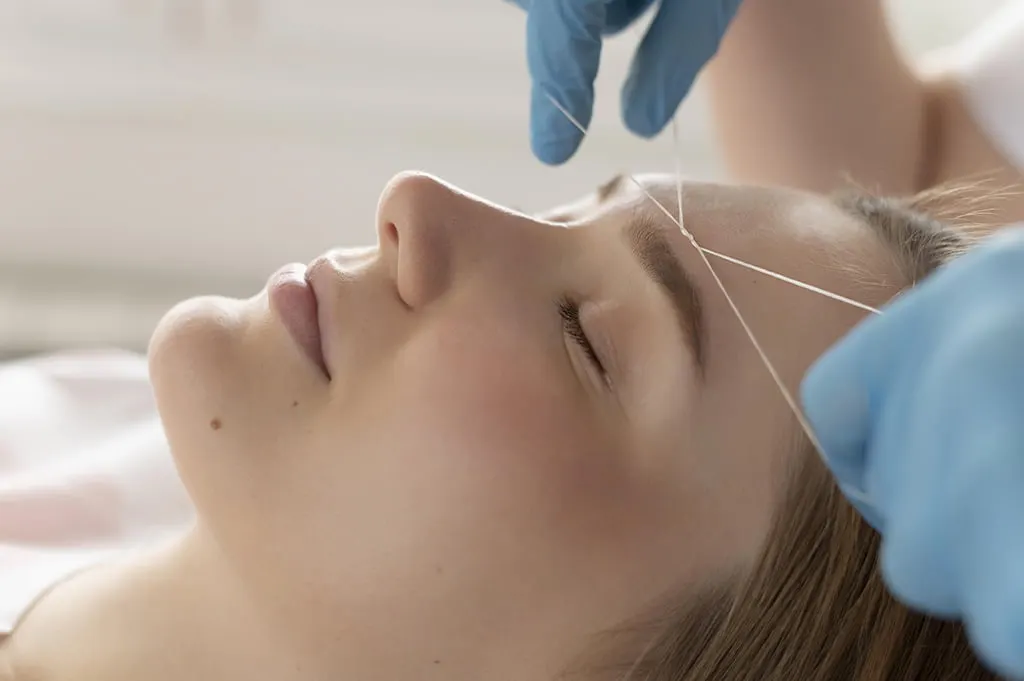
A facial thread lift is what many people know as “thread lifting” or “thread sculpting.” It uses the pulling force of the threads to lift sagging fat and skin upward for a firmer, tighter result. It can also help with the small V-shaped face that has become so popular in recent years.
The principle behind a facial thread lift is that absorbable collagen threads are placed under the skin using a minimally invasive technique. The surface of these threads is covered with tiny barbs, so they distribute tension evenly across the subcutaneous tissue and stimulate collagen production. While lifting, they also add fullness to the face, effectively improving sagging and signs of aging.
How It Differs From Ultrasound and RF Treatments: Facial Thread Lifts Show Results Immediately
Where Can Thread Lifts Be Used?
Thread lifts can be used on a very wide range of areas, which fall into the upper, middle, and lower face, such as forehead lines, the inner brows, apple cheeks, nasolabial folds, jowls, marionette lines, the cheeks, or the neck, so many people treat all the areas they care about in one session.
The lifting effect of a thread lift can last about 12 to 24 months, and the threads are absorbed by the body on their own. How long it lasts also varies with your lifestyle, the threads chosen, the doctor's technique, and your skin condition. People with relatively loose skin may see shorter-lasting results, so we recommend combining a thread lift with hyaluronic acid treatment in the same session to improve longevity and the overall result.
Marionette Lines Hard to Fix? Causes and Types Explained, and How to Treat Each
What to Do About Nasolabial Folds? 4 Non-Surgical Aesthetic Treatments to Get Rid of Them
Types of Thread Materials
There are many kinds of threads. The ones approved in Taiwan include Mint Lift threads, Silhouette Instalift threads, Stratafix threads, barbed threads (V-Loc), and feather threads. Here is a brief look at the features of each:
Mint Lift Threads
MINT Lift is a new-generation thread from South Korea with patent certifications in multiple countries. The polydioxanone (PDO) material can be completely absorbed by the body, and the thread features a one-piece design with 360-degree spiral 3D barbs, which takes the lifting effect to the next level.
Silhouette Instalift Threads
Silhouette Instalift, also known as the “girl thread” or “bell thread,” has multiple polylactic acid cones that stimulate fibroblasts to produce collagen after placement.
Stratafix Threads
Stratafix: compared with other threads, the barbs on Stratafix are blunted before placement, so the thread causes much less pain and post-procedure swelling and discomfort. The patented fixation piece at the end also provides strong support, which is why many patients choose this thread.
Barbed Threads (V-Loc)
One of the common threads, with a 360-degree interlocking barb design. It is also a suture material used in surgery, with three main features: strong pulling force, high safety, and low allergenicity, and it is absorbed by the body. It is very well developed when it comes to safety concerns.
Feather Threads
These use a fixed spiral barb design with very even pulling force. The material is the same as Mint Lift, PDO, and besides offering ample support, they are not prone to migration.
Thread Lift vs. RF and Ultrasound Lifting? Differences and Common Thread Types at a Glance
FAQ
Does a thread lift hurt? Is numbing cream needed?
A: A facial thread lift is an “invasive” aesthetic medicine procedure, so you may feel slight discomfort or a sensation of a foreign object during the procedure. Local anesthesia is given beforehand to reduce pain, and the threads are then placed under the skin through fine needles.
What should I watch out for after the procedure?
A: There are a few key points to keep in mind after the procedure:
1. If your face feels tight, bruised, or your expressions look odd after the procedure, these are all normal, so there is no need to be overly anxious. You can reduce swelling and ease discomfort with cold compresses.
2. You can clean or gently wipe the treated area with saline solution. Avoid excessive poking or rubbing so you do not affect the threads.
3. For three days after the procedure, avoid cigarettes, alcohol, and spicy or irritating foods; for one week, avoid hot places; for two weeks, avoid biting hard foods, dental treatment, and facial massage treatments.
Can a thread lift fail?
A: It can. Invasive treatments really test the doctor's skill and experience. The choice of threads also affects the overall result, so be sure to compare clinics and get several consultations. That way you can avoid ending up with dents or an uneven surface after the procedure.
How can I tell if my thread lift has failed?
A: A failed thread lift can be spotted through a few simple movements or facial reactions, such as: obvious hollowing of the cheeks when you make expressions, skin inflammation, threads protruding so that the skin feels uneven to the touch, or a lifting effect that differs between the left and right sides of the face.
Who is a good candidate for a facial thread lift?
A: The results of facial thread lifts attract many women to ask about them, but not everyone can have this type of treatment. A facial thread lift is not recommended if you have any of the following:
1. Infection in the treatment area, such as dermatitis or acne.
2. Chronic conditions such as diabetes or cardiovascular disease. (If you still want the treatment, we recommend discussing it in detail with your doctor, who will assess whether it is suitable.)
3. Pregnant or breastfeeding women.
4. Keloids or blood-related conditions (such as hemophilia or abnormal blood clotting).
Are thread lifts expensive? What is the minimum number of threads?
A: The cost of a thread lift varies with the material, the treatment area, and the number of threads. Threads are basically priced by the number used, with prices ranging from the thousands to the tens of thousands of NT dollars. We usually recommend at least two threads for a facial thread lift (two on each of the left and right sides) to see an obvious change and effectively address the problem. Of course, it depends on each person's actual situation, so we always recommend visiting the clinic for a consultation and assessment by a professional doctor, who will set the most suitable and necessary number of threads.
P.S. A quiet word from our editor: please do not cut back on the number of threads you need, or switch to a different material, just to save money! Using fewer threads may give weaker results with no visible difference. And of course, placing two threads in one session versus placing one thread at a time across two visits gives very different results!
This article is for general information only. Results vary from person to person; please consult a doctor in person before deciding on any treatment.