
Contents
How important is the nose, really? With a mask on you look great, but with it off, points are deducted, and the problem may lie in the lower half of the face, such as the nose and mouth. Today we look at the rhinoplasty methods that both men and women care about, covering both non-surgical and surgical options. We also explain what a “bulbous nose” is, which you hear about often, and how to check whether your nose shape is in proportion. Let's learn everything about rhinoplasty.
What Is a Bulbous Nose?
A bulbous nose is narrow at the top and wide at the bottom, and is also called a fleshy nose. You can check whether you have one using these features:
(1) The nose tissue is thick and fleshy to the touch
(2) The nasal tip is large and rounded, making the nose take up a larger share of the face
(3) Alar width exceeds the distance between the inner corners of the eyes
In traditional physiognomy, a bulbous nose actually signifies good fortune, wealth, and a supportive influence on one's husband. In recent years, however, under the influence of Korean culture, Korean-style rhinoplasty has gradually risen in popularity, and a slim nasal bridge with a slender, slightly upturned tip is the hallmark of the Korean ideal nose.
Does the Nose Have a Golden Ratio Too? How to Create the Perfect Nose Shape
Why Do People Have a Bulbous Nose?
As mentioned above, a bulbous nose has excess, rounded tissue at the nasal tip, and the cause of an overly round tip is excessive curvature of the lower lateral cartilage (it can also be caused by congenitally thick soft tissue at the nasal tip); if the lower lateral cartilage is smoother, the nasal tip is also relatively smaller.
There are two ways to improve a bulbous nose: structural rhinoplasty and nasal tip sculpting (nasal cartilage adjustment, removal of excess tissue at the tip, and so on). When sculpting the tip, the shaping material props up a rounded, strongly sagging tip, making it look smaller and adding dimension.
Improving a Bulbous Nose: Minimally Invasive Options
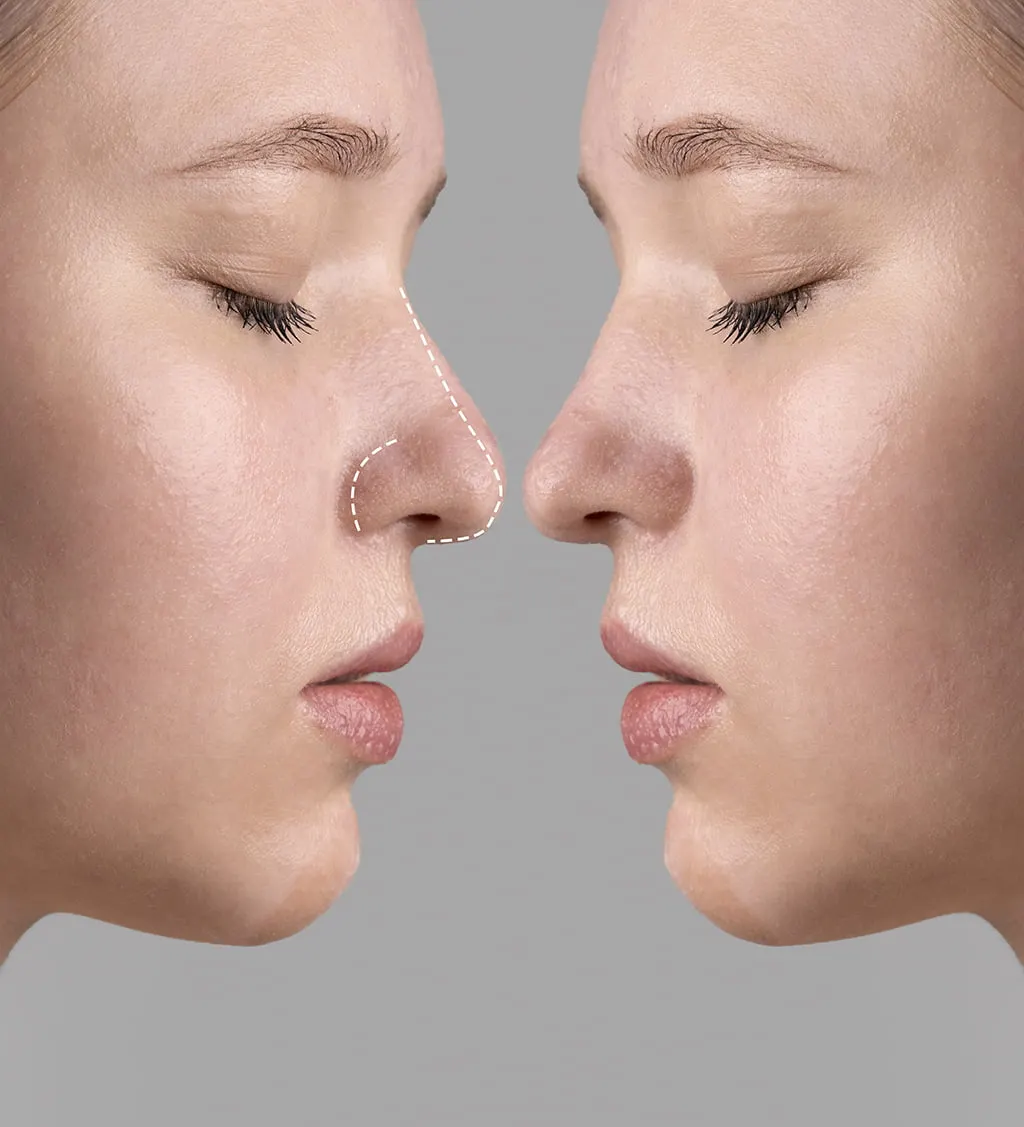
Non-surgical rhinoplasty options include: thread rhinoplasty, hyaluronic acid rhinoplasty, and 4D minimally invasive rhinoplasty
Thread rhinoplasty: uses absorbable protein threads, mainly to improve and sculpt and lengthen the line of the nasal tip. The treatment takes about 15-20 minutes, and results last 10-12 months (this varies by individual constitution).
How it works: Absorbable protein threads are placed into the nose through a needle-hole approach using minimally invasive techniques. The barbs on the threads lift the tissue and, together with the angle at which the doctor places them, sculpt and raise the nose. A multi-angle, multi-layer, multi-plane implantation technique is used, targeting the nasal dorsum, alar, tip, nasal base, nostril, and columella zones, sculpting zone by zone to create a distinctive three-dimensional look and a beautiful golden angle for the nose shape.
Hyaluronic acid rhinoplasty: uses large-molecule hyaluronic acid injections, taking advantage of its water retention and supportive properties to refine the nose shape. The treatment takes about 10 minutes, and results last 6-8 months.
How it works: It uses synthetic hyaluronic acid, a colorless, odorless, clear gel-like substance that, once injected into the body, fills hollows, adds volume to tissue, and creates a full, plump look. Hyaluronic acid rhinoplasty injects the product into the periosteal and fascial layers of the nose to improve a flat nose, adjust the bridge, and rebuild the side lines of the nose for an ideal nose shape. Hyaluronic acid is also a “keep your options open” choice: it is fully absorbed or broken down and metabolized by the body, and its price is relatively approachable.
Korean-style 4D minimally invasive rhinoplasty: combines the two methods above, using medical-grade collagen threads plus injected hyaluronic acid to form a natural, three-dimensional framework, with results lasting 2-3 years, which lasts longer than fillers and can also lengthen the columella and narrow the alae to improve the nasal tip.
The procedure takes only 30 minutes. 4D minimally invasive rhinoplasty uses absorbable threads made for nose sculpting, and because hyaluronic acid is also injected, even after the threads are absorbed by the body, collagen production is still stimulated, so you need not worry that the nose will keep getting wider the more you do!
Improving a Bulbous Nose: Surgical Options

Common surgical rhinoplasty options: traditional rhinoplasty, Korean-style rhinoplasty, structural rhinoplasty
All of them require surgically placing natural or artificial implants in the proper position in the nose to fill in or reshape it. Surgical rhinoplasty provides better support and durability, but it also carries the risks of invasive surgery, such as scarring, bruising, implant shifting, implant protrusion through the skin, and a long recovery period.
Surgery is performed under general anesthesia or sedation anesthesia, so you need to consider whether your health allows it. We recommend a health checkup and a preoperative consultation before surgery for safety.
Traditional rhinoplasty surgery, also called one-segment rhinoplasty, places an I-shaped or L-shaped implant inside the nose, mainly to raise the nasion and nasal bridge. Traditional rhinoplasty uses no custom carving; the implant is placed directly to raise the bridge, so it does not noticeably change the shape, length, or angle of the nasal tip. It suits people whose original nose is in good condition, whose tip and alae need no improvement, and who only need a higher bridge.
Korean-style rhinoplasty surgery, also called two-segment rhinoplasty, places an I-shaped or L-shaped implant inside the nose and places the patient's own ear cartilage or rib cartilage in the nasal tip, mainly to raise the nasion and bridge and to shape the tip, which fixes the problem of the implant poking through that one-segment rhinoplasty has and adds tip height.
To improve a bulbous nose, we recommend structural rhinoplasty surgery, also called three-segment rhinoplasty surgery, which places a custom-carved I-shaped implant at the nasion to raise the bridge, and uses ear cartilage plus autologous or donor rib cartilage at the tip to lengthen the septum and increase tip support, which also lowers the chance of the tip poking through.
Structural rhinoplasty allows larger adjustments and can address all kinds of nose shape problems; everything from the bridge, dorsum, tip, and alae to the nostrils can be sculpted, and it can make fine adjustments for upturned noses, overly wide alae, collapsed tips, and more.
Gore-Tex Rhinoplasty Surgery | A Natural Nose Tailored to You, Raising Your Looks to New Heights!
Chimera Rhinoplasty Surgery | A Composite Implant to Create a High, Straight Nose
Autologous Rib Cartilage Rhinoplasty | Natural Results, Low Rejection, Very High Safety
Post-Procedure Precautions
Minimally invasive procedures:
1. After the procedure, you will have mild swelling for about 3-4 days. Artificial skin is applied over the needle holes right after the procedure, and the wounds heal in about 1-2 days.
2. After the procedure, avoid rubbing or squeezing the nose, and do not scrunch the nose.
3. After the procedure, do not pinch the nose hard, and avoid constantly touching the wounds on the nasal tip.
Surgical procedures:
1. When icing after surgery, do not press on the nasal tip. Apply ice to the nasion and the swollen areas around the eyes.
2. Ice 7-8 times a day for the first week after surgery, about 10-20 minutes each time.
3. After surgery, avoid sleeping on your stomach and avoid wearing glasses as much as possible for one week, so as not to put pressure on the nasion.
4. After surgery, avoid bending over or lowering your head. Bloody fluid seeping out during the first three days is normal.
5. After surgery, pay special attention to eye cleanliness to avoid eye inflammation such as red eye and conjunctivitis, which can spread infection to the nose through the nasolacrimal duct.
This article is for general information only. Results vary from person to person; please consult a doctor in person before deciding on any treatment.