Contents
A good-looking nose does not mean the higher the nasal root, the better! Today's aesthetic is no longer about a tall nasal bridge alone. Greater emphasis is placed on refined nostril wings and nasal tip, combined with the angles of the nose, to balance facial proportions and create a perfect nose that is natural and three-dimensional. This article explains how to assess your nose type, what the golden ratio of the nose is, and introduces three aesthetic medicine approaches for shaping a perfect nose.
6 Common Nose Types Explained
1. Upturned nose
Also called a short nose, it has a short nose length and an upturned tip, with the line from the nasal tip to the nostrils angled upward by more than 30 degrees, leaving the nostrils overly exposed. This easily throws the face out of visual focus, and it is mainly caused by a nasal tip that is too short, a nasolabial angle that is too large, or nostril wings that droop too much on both sides. It is a nose problem more common among East Asians, and in face reading an upturned nose is said to make money slip away.
2. Bulbous nose
The nose is narrow at the top and wide at the bottom, with fleshy, rounded tissue, an oversized tip, and flared nostril wings, out of proportion with the nasal bridge. It gets its name because the shape looks like a garlic bulb or a wax apple. Combined with a flat nasal root, the whole nose lacks dimension, and the face can look wide.
3. Hooked nose
The main features are a nasal tip that is too long and droops, with the tip covering part of the philtrum. From the side it looks like a downward-hooked eagle's beak, and it is usually accompanied by a humped nose, meaning the bridge bulges at the junction of the bony part and the upper lateral cartilage, forming a hump shape. It is caused by overdevelopment of the nasal bones from birth, or by trauma that leaves the nasal bones misaligned after healing with excess callus growth. From the side the bridge looks high, but with an uneven curve.
4. Saddle nose
A saddle nose is a nose type common among East Asian women. It is caused by insufficient support from the nasal bone or septal cartilage. The bridge is sunken with irregular drops in the middle section, and combined with a short, upturned tip, the nose looks like a U-shaped saddle from the front. In severe cases it can come with an upturned nose as well.
5. Lion nose
Because the nostril wings flare outward too noticeably, the nostrils look too large, like the nose of a lion. In addition, with a wide, flat bridge and a rounded tip, the full nostrils can be seen from the front, and the nose looks round.
6. Crooked nose
This may be caused by a congenitally deviated septum or by external trauma later in life. By location of the deviation, it can be deviation of the cartilage at the nasal tip or deviation of the bony part at the nasal root, and it can also involve asymmetry or deviation of both cartilage and bone at once, making the entire nose crooked.
What Is the Golden Ratio of the Nose?
The nose runs from the forehead through the nasal root, dorsum, tip, columella, and nasolabial angle to the lips. To achieve the golden ratio, pay attention to these 3 aspects:
1. Front view
Using the "three sections, five eyes" rule, divide the face into 15 equal parts
- Nose length makes up one third of the face's length
- Nostril wing width makes up one quarter of the face's width
- The nasal bridge is a straight line perpendicular to the center of the face
- The nasal tip and the nasolabial folds on both sides form an isosceles triangle
2. Side view
Taking the nasal root as the reference point, the ratio of the length from the root to the nasal tip to the length from the nasal tip to the nostril wings is 1:0.67
| Area | Description | Angle |
|---|---|---|
| Nasofrontal angle | The angle formed by the nasal bridge and the forehead at the nasal root | About 115-135 degrees |
| Nasal tip angle | The angle of the nasal tip | About 85-90 degrees |
| Nasolabial angle | The angle between the lower edge of the nostrils and the upper lip | About 90-115 degrees |
3. Bottom view
- Viewed from below, the nasal tip forms an equilateral triangle
- The angle from the nasal tip to both nostril wings is 90 degrees
- The ratio of the nasal tip to the nostrils is 1:2
3 Aesthetic Medicine Treatments for Sculpting the Nose
1. Rhinoplasty
An artificial implant or autologous tissue is placed to support the nose and adjust its shape. Common implant materials on the market today include Gore-Tex, Chimera, and second-generation silicone Bistool. Surgical approaches are divided into one-stage, two-stage, and three-stage rhinoplasty. These options make it possible to customize a nose shape to each person's needs.
[Material Comparison]
| Gore-Tex rhinoplasty | Chimera rhinoplasty | Second-generation silicone Bistool | Autologous rib cartilage | |
|---|---|---|---|---|
| Feel | Good | Good | Moderate | Best |
| Material | Gore-Tex | Silicone + Gore-Tex | Silicone | Rib cartilage |
| Advantages | Customizable sculpted nose shape; does not easily shift or bend after surgery | Customizable sculpted nose shape; combines the advantages of silicone and Gore-Tex | Many models available; affordable price | No rejection issues; easy to sculpt |
| Risks | More difficult to remove if the material needs to be replaced in the future | People with thin skin may develop a reddish shine over the bridge of the nose | Capsular contracture rate is higher than with other materials | May be absorbed or deformed over the long term |
| Capsular contracture rate | Very low | Very low | Moderate | X |
| Tissue compatibility | ★★★★ | ★★★ | ★★ | Fully compatible |
| Price | ★★★★ | ★★★ | ★★ | ★★★★★ |
[Surgical Method Comparison]
| One-stage (conventional) rhinoplasty | Two-stage rhinoplasty | Three-stage rhinoplasty | |
|---|---|---|---|
| Implant | I-shaped / L-shaped implant | Implant + autologous cartilage tip graft | Implant + autologous cartilage tip graft + septal extension / glabella augmentation |
| Incision | At the nostril wings | Inside the nostrils | Inside both nostrils and at the columella |
| Advantages | Short surgery time; corrects a collapsed nasal root | Short surgery time; implant is less likely to protrude through the tip; scar is not obvious | Allows fine sculpting of the nose shape; natural results; high safety |
| Disadvantages | Low malleability; not suitable for tip problems; risk of the implant protruding | Limited malleability | Recovery period; longer surgery time |
| Recovery | About 7-14 days | About 14-21 days | About 21-30 days |
| Best for | People with a good overall nose shape who only want to raise a low bridge | People with a collapsed tip or bridge | All nose types |
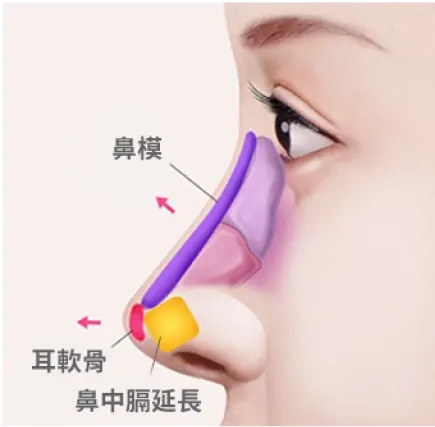
Rhinoplasty Aftercare: The Most Complete Guide
2. Hyaluronic acid filler injection
- How it works: Using the high water retention and filling ability of hyaluronic acid, injection technique creates a stable support under the skin of the nose and improves its shape.
- Results: Hyaluronic acid molecules have good biocompatibility, so side effects after injection are relatively few, but the results gradually fade over time and usually need a top-up every 6-12 months, and results vary with each person's constitution and metabolic rate.
- Who it suits:
(1) People with a decent nose who want a minor adjustment
(2) People who want to see results in a short time
(3) People who do not want to take on surgical risk
(4) People who want to preview the effect before rhinoplasty surgery
- Advantages: Lower price, no surgery needed, short treatment time, small wounds, short recovery period
- Disadvantages/complications: Limited improvement, risk of thrombosis, and the filler may spread outward
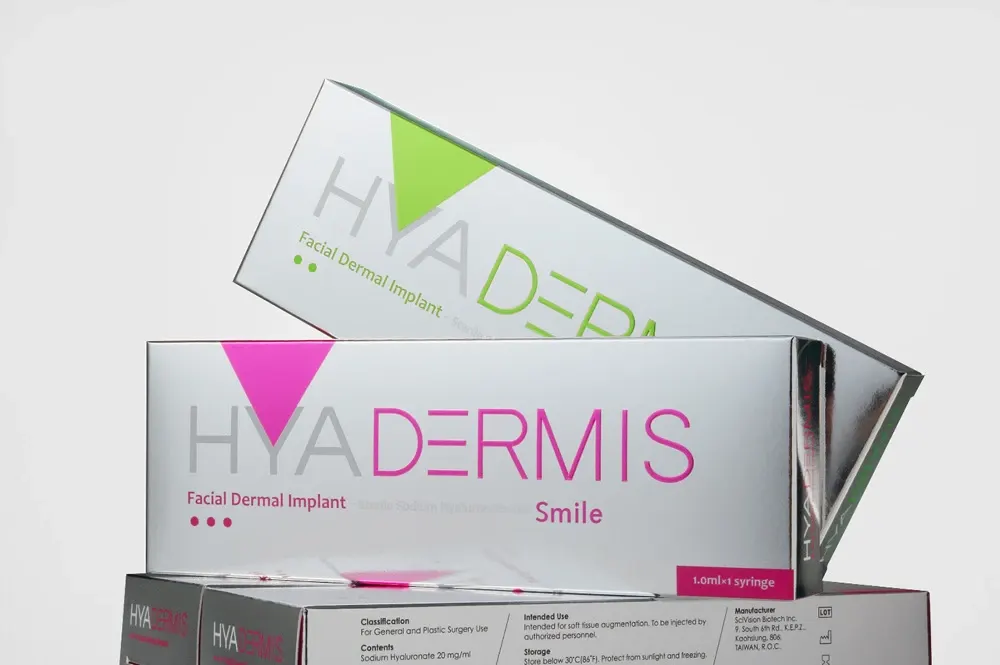
[Recommended hyaluronic acid treatments: Hya-Dermis hyaluronic acid filler, Juvéderm hyaluronic acid filler]
3. Nose thread lift
- How it works: Through a needle puncture at the nasal tip, absorbable protein threads are implanted into the body, and the barbs on the threads together with the angle at which the physician places them achieve the goal of sculpting the nose.
- Results: Last about 1-2 years; as the body absorbs the protein threads, the effect gradually fades.
- Who it suits:
(1) People with a short nose
(2) People with a collapsed nasal root or a crooked bridge
(3) People who want a short procedure and quick recovery
(4) People who do not want to take on surgical risk
- Advantages: High safety, short treatment time, small wounds, short recovery period
- Disadvantages: Not permanent, cannot change the nose shape dramatically, possible risk of the thread protruding
[Common nose thread types: Stratafix (Blue Diamond fishbone thread) and Timella Rose threads]
Whichever treatment you choose, we recommend evaluation and discussion with a professional physician. A physician's skill is one of the key factors in whether treatment succeeds, and seeking a highly reputable, experienced physician is the way to ensure treatment quality and a good treatment experience!
This article is for general information only. Results vary from person to person; please consult a doctor in person before deciding on any treatment.