
Contents
Are eye bags bothering you? Do they make you look older and tired? Eye bag surgery can solve the problem, but how should you care for yourself afterward? How can you speed up the reduction of swelling? Should you use cold or warm compresses after surgery? This article tells you everything about aftercare for eye bag surgery!
The 3 Types of Eye Bags
Eye bags are three-dimensional bulges that makeup cannot cover. Eye bags sit below the aegyo sal and are about 2 to 3 times as thick, and they are either congenital or acquired. Congenital eye bags are mostly hereditary, with naturally thicker fat under the eyes. Acquired eye bags result from aging, eye overuse, and long-term pulling around the eyes, which makes the orbital fat protrude and creates noticeable eye bags.
Aging type: Aging-type eye bags develop as age increases and the skin around the eyes ages and loosens, letting the fat around the eyes slide downward under gravity and forming eye bags that sag and bulge outward.
Edema type: Edema-type eye bags, also called puffy eyes, are eye swelling usually caused by staying up late, drinking too much water before bed, or eating too much salt. The sodium in salt makes the body retain water, and when the area around the eyes soaks up water, swelling easily occurs. It often shows up when you get up in the morning and usually improves after a few hours.
Hereditary type: Hereditary eye bags usually occur in younger people and are mostly caused by congenital "excess fat accumulation," which makes the orbital fat protrude and form eye bags.
[Further Reading]
5-in-1 Hidden-Scar Eye Bag Surgery
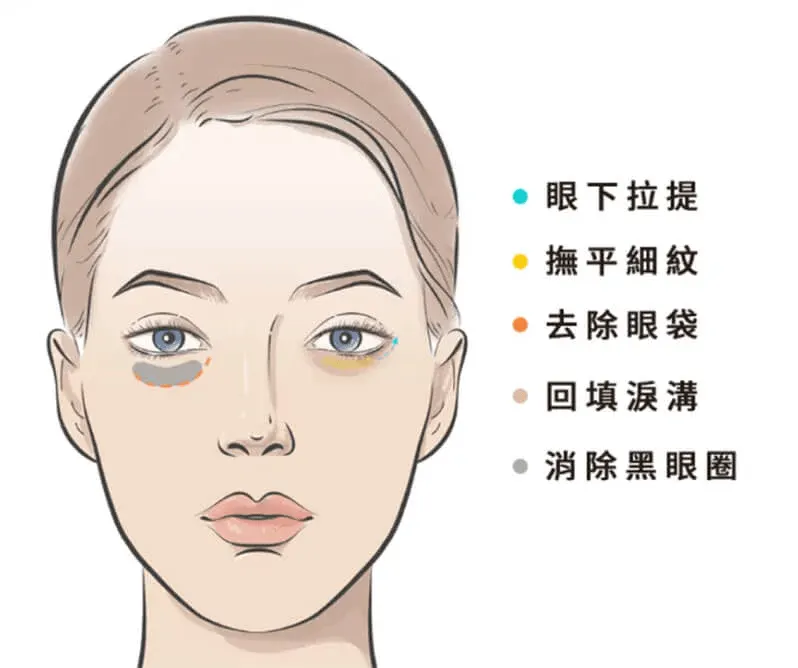
"5-in-1 hidden-scar eye bag surgery" combines the advantages of internal (transconjunctival) and external (transcutaneous) eye bag surgery. It avoids the aegyo sal and the lower eyelid tarsal plate, targets the eye bag fat layer directly, and after removing the fat, fills it into the tear trough hollow. With 5-in-1 hidden-scar eye bag surgery, one procedure resolves 5 major concerns around the eyes: removing eye bags, filling tear troughs, improving dark circles, smoothing fine lines under the eyes, and improving firmness in the under-eye area.
Because the wound of 5-in-1 hidden-scar eye bag surgery is hidden on the inner side of the eyelid, there is almost no visible trace of the wound afterward. You can return to normal life the next day with no disruption to your routine, and the recovery period after surgery is about 5 to 7 days.
Pre-Surgery Restrictions

Do not use aspirin-type drugs or anticoagulants within 2 weeks before surgery
People with keloid or hypertrophic scarring tendencies should tell the doctor
On the day of surgery, do not wear contact lenses, and remove any eyelash extensions
Do not take blood-circulation-boosting herbs such as ginkgo and ginseng before surgery
Normal Side Effects After Surgery
Within 1 week after surgery, you may experience eye swelling, bruising, inflammation, and asymmetry between the eyes. These are all normal and vary with each person's constitution, age, and so on. Please follow your doctor's instructions and keep a regular routine, and the side effects will improve. If you feel your condition is getting worse, return to the clinic promptly and seek the doctor's help.
Aftercare Quick Guide
1. The Wound
With internal (transconjunctival) surgery, there is no visible incision. With external surgery, there is a fine, light red incision line along the lower edge of the eyelashes, which fades and becomes hard to see after about three to six months.
External surgery: Stitches can be removed 5 to 7 days after surgery. Until the stitches are removed, avoid getting the area wet, and wipe your face instead of washing it for now. If the wound gets wet by accident while bathing, washing your hair, or washing your face, care for it by changing the dressing as your doctor instructed. For the first three days, ice the wound as much as possible; after three days, switch to warm compresses. Apply each for about 10 to 15 minutes, then resume cold compresses after an hour. How often depends on your convenience, so ice whenever you have time.
2. Diet
Do not smoke, drink alcohol, take Chinese herbal medicine or heat-inducing tonics, or eat chili peppers or other irritating foods. Drink as little coffee and tea as possible, drink less water before bed, and avoid fruits with very high water content so that swelling does not develop the next day. Eat more high-quality protein and natural vegetables and fruits, which can effectively help the body recover more efficiently.
3. Daily Life
For 2 weeks, avoid wearing contact lenses and tilting your head back or lowering it too far and similar movements, and avoid emotional excitement or lifting heavy objects to prevent wound swelling and bleeding. For 1 month, no strenuous exercise such as basketball, cycling, or swimming. Avoid staying up late and overusing your eyes, get enough sleep, and reduce screen time. You will inevitably feel itching during healing, but you must avoid rubbing with your hands.
4. Cold Compresses vs. Warm Compresses
Use cold compresses frequently for the first three days after surgery to reduce bleeding, swelling, and pain. After that, cold compresses remain the basic approach, because the tissue around the eyes is thin and there is a period of blood vessel regrowth and repair after surgery, so applying heat too early can increase the chance of bleeding.
5. Possible Complications
If not handled well, there is a risk of heavier bleeding and wound infection, and it may even lead to adverse effects such as double vision and reduced vision.
This article is for general information only. Results vary from person to person; please consult a doctor in person before deciding on any treatment.