Contents
What? Some people are actually troubled by breasts that are too large? When it comes to breast concerns, most people think only of breast augmentation, yet a small number of women are genuinely bothered by very large breasts. And of course, men can have this problem too! Most of us have heard of “gynecomastia,” and this condition can be improved through surgery. People who want to remove female secondary sex characteristics will also find this article useful. Today our editors have put together the surgical options for anyone who wants to reduce breast size. Let's take a look!
When Large Breasts Become a Problem
Concerns about large breasts fall into three main categories:
1. Concerns About Breast Size
The most common concerns are almost always uneven breast size, a flat chest, and breast shape, which is why many people choose implant or fat-transfer breast augmentation to enhance their femininity and gain more confidence. As attitudes have shifted, breast augmentation has become a popular topic, but a small number of women are troubled by the opposite problem: breasts that are too large. Overly large breasts can create a feeling of pressure on the chest and make breathing uncomfortable (this varies with each person's body type).
In addition, long-term friction along the edges of the breasts can easily cause eczema, itching, and broken skin. Large breasts can also sag even at a young age (and bras are hard to find), all of which add to the burden.
2. Gynecomastia (Male Breast Enlargement)
As the name suggests, this means a man develops breasts similar to a woman's. Typical symptoms include protruding nipples, an enlarged areola, and breast gland swelling and pain, among others. These not only affect appearance but also overall confidence, and the most awkward part is that gynecomastia is hard to improve by losing weight and cannot be trained away through exercise! (P.S. Gynecomastia is a problem of the mammary gland, not of fat.)
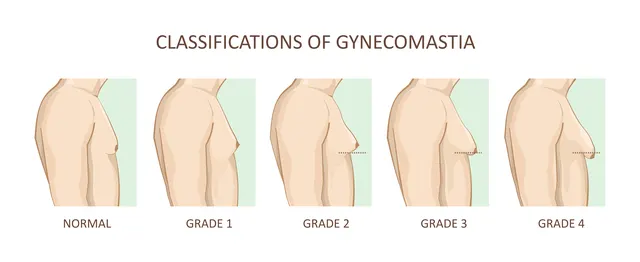
What is gynecomastia? A one-step self-check and a full look at treatment options
3. Those Who Want to Remove Female Secondary Sex Characteristics
Social attitudes are gradually improving and becoming more diverse and open. In 2019, Taiwan became the first country in Asia to legalize same-sex marriage, and lesbian individuals no longer need to be confined by gender frameworks. Through flat chest surgery, they can shed female breast characteristics and the stuffy discomfort of wearing a chest binder for long periods.
Comparing Four Types of Breast Surgery
| Breast surgery | Gynecomastia surgery | Cohesive gel silicone breast augmentation | Flat chest surgery | Breast reduction and lift |
|---|---|---|---|---|
| Surgical method | Fat is removed by liposuction through an incision of about 5 mm, and excess glandular tissue is taken out through the lower edge of the areola | With endoscopic assistance, implants are placed beneath the breast to achieve a full, rounded shape and size with the desired look and feel | The tissue of both breasts is removed, with the mammary gland and fat resected, and the position of the nipple and areola is adjusted, with an appropriate reduction of their size | Based on the concept of a flap procedure, the glandular tissue is shifted upward and re-secured to the chest wall. |
| Surgery time | About 3 hours | About 2-3 hours | About 3-4 hours | About 3-5 hours |
| Recovery | Back to normal work after 3 days; avoid lifting heavy objects and other strenuous work | About 2 weeks | About 2-4 weeks | About 1 week |
| Incision size | 15-20 mm | 4-5 cm | 3-4 cm | 20-30 cm |
| Suitable for | People with female breast characteristics: 1. Protruding nipples 2. Enlarged areola 3. Breast gland swelling, pain, or atrophy | People seeking their ideal breasts: 1. Congenital underdevelopment 2. Asymmetrical breasts 3. Lack of upper breast fullness 4. Postpartum sagging and shrinkage 5. Need for breast implants | People who wish to remove female secondary sex characteristics | People with very large breasts who have the following concerns: 1. A feeling of pressure that makes breathing difficult 2. Skin eczema from long-term friction along the lower edge of the breasts 3. Sagging caused by overly large breasts |
What Are the Types of Flat Chest Surgery?
Minimally Invasive Areolar Flat Chest Surgery
Also known as crescent-type flat chest surgery. The mammary gland is removed through a 3-4 cm semicircular incision at the areola. No extra skin or areola is removed during the operation, so there is less risk of the areola losing sensation. However, because it cannot deal with excess skin or an overly large areola, minimally invasive areolar flat chest surgery is only suitable for small breasts (A-B cup), with no sagging, and with good skin elasticity. Although the scar afterward is hidden and inconspicuous, this procedure places higher demands on the patient's breast type.
Circumareolar Flat Chest Surgery
Also known as “donut flat chest surgery,” a circular incision is made around the areola to remove the breast and mammary gland completely, and excess skin can be removed and the areola reduced at the same time. Donut flat chest surgery is therefore suitable for removing large-cup breasts that do not sag much. The scar is hidden around the areola, so it is less likely to leave a noticeable scar, and it can be considered a more ideal technique. However, it is important to note that it is not suitable if the breasts sag severely.
Straight-Line Incision Flat Chest Surgery
The breast, mammary gland, and excess skin can all be removed completely, which makes this approach suitable for most fuller breasts and for severely sagging breasts. The straight-line incision makes it easier for the surgeon to remove and sculpt the breast, and the chest is usually flatter after surgery. At the same time, however, it leaves a noticeable permanent scar along the lower edge of the chest, and the nipple and areola must be completely removed and grafted during surgery, so there may be a risk of poor graft survival or necrosis, or aftereffects such as nipple nerve damage and reduced sensation.
| Minimally invasive areolar flat chest surgery | Donut flat chest surgery | Straight-line incision flat chest surgery | |
|---|---|---|---|
| Pros | 1. Small incision of only 3-4 cm 2. Short recovery period 3. Inconspicuous scar after surgery | Reduces the areola and lifts the skin at the same time. | Areola and nipple reduction are completed in one procedure, so the revision rate is low. |
| Cons | 1. Not suitable for severely sagging breasts 2. High technical skill required | Blood circulation to the areola and nipple is easily affected, which may result in noticeable scarring, areola deformity, or necrosis. | The scar is longer and more noticeable. |
Flat Chest Surgery Is Irreversible: What to Know Before Surgery
Q: Can a flat chest only be achieved through surgery?
Q: Will it leave a scar?
Q: Are the changes to the nipple irreversible?
The Key to Successful Surgery
Flat chest surgery is an “irreversible” invasive procedure, so choosing the surgeon is critical. For example, nipple positioning and the aesthetic result after surgery both test the surgeon's artistic sense, experience, and technical skill. Choosing the right surgeon is half the battle! Do plenty of research before surgery, along with pre-operative testing and a consultation, to confirm the professionalism, background, and surgical experience of the medical team, as well as the environment, equipment, and reviews of the aesthetic clinic. Last, and most important, is the anesthesiologist. For a major operation like this, general anesthesia is always used, so whether an anesthesiologist stays with you throughout the procedure is a key factor in how the surgery goes!

NAISS CLINIC has spared no expense in recruiting teams of experienced plastic surgeons from National Taiwan University Hospital, Taipei Veterans General Hospital, Chang Gung Memorial Hospital, and other leading hospitals, who practice on site. With top physicians who each specialize in a different field, patients with different needs can all receive the most professional treatment advice. During surgery, an anesthesiologist stays with the patient throughout to ensure safety and to provide immediate support in an emergency, keeping all risks to a minimum.
The environment matters just as much. The clinic has a third-party-certified cleanroom operating room and a professional air shower room to make sure surgery is carried out in a safe, sterile environment and to prevent post-operative bacterial infection. Finally, NAISS CLINIC offers patients a dedicated post-operative recovery program that addresses the scarring concern most surgical patients worry about, including scar-reducing injections, pigment-lightening laser, photon (IPL) skin repair, and swelling and inflammation care to speed up wound recovery and reduce swelling. Dedicated staff also provide one year of post-operative follow-up, so you can have complete peace of mind receiving any surgical treatment at NAISS CLINIC.
This article is for general information only. Results vary from person to person; please consult a doctor in person before deciding on any treatment.