Contents
A tear trough hollow makes you look especially tired and low on energy. Do you know how tear troughs form? Hyaluronic acid filler is probably the most common aesthetic treatment for tear troughs, so what should you pay attention to in order to improve them effectively while keeping a natural, attractive look? This article not only explains the three main causes of tear troughs, but also shares the five key tips you need to know for treating them, so you can effectively get rid of that tired look.
Tear Trough Cause 1: Ligament Pull
The tear trough lies below the eye bag, where it connects the bone and the dermis. Everyone has a tear trough ligament that pulls the skin downward. If the ligament pulls too strongly, a hollow forms, which is the tear trough you see on the surface. This is a condition caused by congenital connective tissue, and it is also why some people have tear troughs in childhood.
Tear Trough Cause 2: Fat Loss
When you are young, collagen and fat are plentiful and the face is full, so tear troughs are hard to notice. But as you age, loss of collagen and fat pads leaves the midface sunken and unsupported, and the tear trough gradually becomes more prominent.
Tear Trough Cause 3: Bone Recession
Bone is actually absorbed by the body over time. Young people have narrow eye sockets, while older people's eye sockets become wider and recede. This is because bone recedes during aging, and insufficient underlying support makes the tear trough deeper and deeper. Like fat loss, it is one of the ways in which aging makes tear troughs worse.
Tip 1: Fill the Underlying Support
Hyaluronic acid, collagen, and fat grafting are common ways to treat tear troughs. From the causes above, you can see that tear troughs form from problems in both the superficial and deep layers, so whichever treatment you choose, both structures need to be filled. Filling usually starts in the superficial layer and then lays a base in the deep layer, supporting the tear trough at both depths. If only the superficial layer is injected, the thin skin around the eyes can easily show lumps or bumpy granules.
Tip 2: Choose the Right Hyaluronic Acid Formulation
The causes of tear troughs involve many different layers, from the looseness and thickness of the skin, the amount of fat, muscle contraction, and ligament tightness, to bone position and size. So injecting a single formulation cannot solve everything at once. In addition, the tear trough area is very expressive, and the muscle pushes upward when you smile, so if a material that is too firm is used, it can form an unnatural lump when you smile.
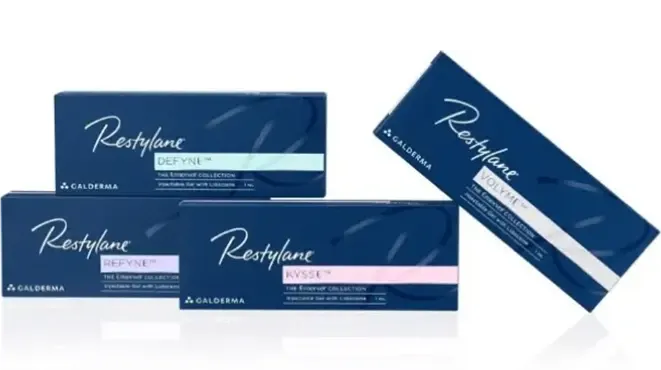
So when choosing a formulation, it is best to choose a springier material, such as Restylane Goddess Dynamic hyaluronic acid, which looks more natural and attractive once injected. Also note that some hyaluronic acid materials absorb water very strongly and can cause swelling some time after injection, producing puffy “bubble eyes”.
Learn more:
Hyaluronic Acid Brands Compared! Which One Suits Me Best?
Tip 3: Injection Posture
During a typical aesthetic injection, the patient lies back or reclines. But when performing tear trough injections, the best posture is sitting completely upright, to simulate how you normally look when facing someone eye to eye. In addition, during the injection the patient should keep both eyes open throughout, so that the improvement of the tear trough can be observed as the injection proceeds, which allows more precise control of the dose and further fine adjustments.

Tip 4: Injection Location and Dose
The tear trough hollow is very clearly defined, but the same dose is not injected along the whole curved trough. Usually, the very bottom of the U-shaped curve is the most sunken, so it receives the largest dose, while the outer end near the outside of the eye gets a medium dose, and the hollow at the inner corner of the eye, near the nose, gets the least filler. The reason is that the skin there is thin and there is very little soft tissue, with bone directly under the skin and a muscle in exactly that spot. If too much filler is injected into the muscle, it will bulge when the muscle contracts, which looks very unnatural.
Learn more:
How Do Hyaluronic Acid Molecule Sizes Differ? Recommended cc Amounts for Popular Areas!
Tip 5: Injection Angle and Depth
There are many injection angles for tear troughs. Some doctors prefer to follow the direction of the tear trough and inject in a line while withdrawing the needle, some inject from the cheek below the tear trough, using a single entry point to inject in a fan pattern toward the tear trough, and some prefer to insert the needle perpendicular to the skin surface and inject at multiple points. Sometimes several techniques even need to be combined to get the best result, and the most important thing is that the doctor's own skill and feel are well practiced, so that too much is not injected at once. At the same time, the doctor must also clearly avoid blood vessels to prevent bruising.
Tear trough filling also needs a combination of different molecular weights, placed at different depths, for a good result. If large-molecule hyaluronic acid is placed in the superficial layer, it easily forms lumps; if small-molecule hyaluronic acid is placed in the deep layer, it is broken down by the body very quickly, and the result is greatly reduced.
Learn more:
Fix Dark Circles and Tear Troughs at Once, Easily, With Injections!
This article is for general information only. Results vary from person to person; please consult a doctor in person before deciding on any treatment.