Contents
“What is the difference between RF and ultrasound?”
RF and ultrasound (HIFU) lifting are both common non-invasive aesthetic treatments that use different types of energy at different skin depths to tighten and lift the skin. Both have short downtime, but they differ clearly in how they work, treatment depth, how results show, and who they suit. This article walks you through the main differences between RF and HIFU lifting so you can choose the treatment that suits you.
RF Skin Tightening vs. HIFU Lifting: How They Work
RF:
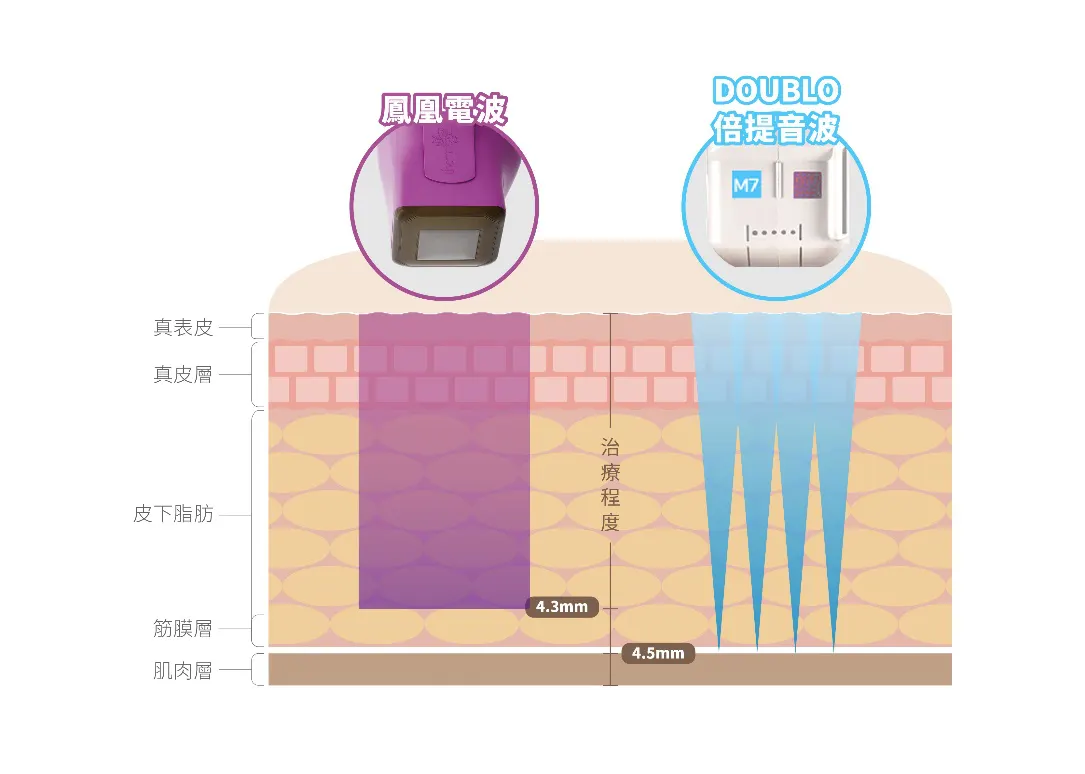
RF energy passes from the epidermis through the dermis to the fat layer, heating the whole block of skin tissue “volumetrically” from the outside in. Think of the skin tissue as a large piece of meat: when heated, it shrinks in volume, while collagen and elastin production is stimulated. As collagen realigns, the skin becomes denser, facial contours firmer, and the skin more elastic, which smooths wrinkles and lines and improves enlarged pores.
HIFU:
HIFU uses ultrasound to generate energy that passes through the epidermis and focuses at the depth of the fascia layer, heating the deep fascia in a “spot” pattern from the inside out. Imagine the fascia as a thin slice of meat that curls up when exposed to high heat. When the fascia contracts, it pulls on the skin tissue and muscle, creating an upward lift and sharpening the contour.
Put simply, RF is like ironing clothes with an electric iron, making the surface skin firmer, while HIFU gives the skin an overall “upward lift.” RF delivers energy 4.3 mm below the epidermis, mainly acting on the dermis; HIFU delivers energy 4.5 mm below the epidermis, mainly acting on the fascia layer. The different depths of energy delivery produce different effects.
RF Skin Tightening vs. HIFU Lifting: Who They Suit
RF:
RF suits people with loose or sagging skin tissue, or fuller faces. Nasolabial folds, forehead lines, or marked jowls can all be addressed with RF, which also firms the skin so the overall look appears younger.
HIFU:
HIFU suits people whose skin is still elastic but whose fat is not too thick, such as those with a double chin or baby fat. HIFU facial lifting can improve the jawline and make the whole face look a size smaller.
However, for people with a thick fat layer, HIFU cannot focus on the fascia layer and so cannot produce a lifting effect. And for people whose skin is too loose and inelastic, even if HIFU contracts and lifts the deep fascia, no result will be visible.
If the skin has both laxity and sagging, a customized treatment combining RF and HIFU is better suited. But since every case is different, we recommend consulting a professional doctor before deciding on the customized treatment plan, rather than trying it out of curiosity, which could waste your money and still not reach the improvement you expect.
RF Skin Tightening vs. HIFU Lifting: How Long Results Last
RF:
RF skin tightening is a one-time treatment whose effect lasts about 2 years, though the actual duration depends on your constitution, rate of aging, and lifestyle habits. As collagen keeps remodeling in the body, skin firmness becomes more and more noticeable within 6 months after treatment.
HIFU:
HIFU lifting is a one-time treatment whose effect lasts about 1 year. Basically, 80% of the expected result is reached in 1 to 2 months, and the full expected result shows at 6 months. If you do not feel an obvious effect after HIFU, a possible reason is that the treated area has more fat: although the fascia layer is pulled upward, the excess fat pulls the whole area back down, so you do not feel the lifting effect.
RF Skin Tightening vs. HIFU Lifting: Choosing a Device
RF:
There are currently 2 mainstream RF skin-tightening treatments on the market: the 3rd-generation Thermage CPT and the 4th-generation Thermage FLX:
| Type | 3rd-Generation Thermage CPT | 4th-Generation Thermage FLX |
|---|---|---|
| Treatment areas | Full face, neck, arms, abdomen, buttocks, thighs and calves | Full face, neck, arms, abdomen, buttocks, thighs and calves |
| Treatment time | 60-90 minutes | 45-60 minutes |
| Duration of results | 1 year to 1.5 years | 1.5 to 2 years |
| Comfort | ★★★ | ★★★★★ |
| Pain level | ★★ | ★ |
| Downtime | None | None |
HIFU:
| Type | Ultherapy | Ultraformer MPT | Doublo |
|---|---|---|---|
| Treatment areas | Full face only | Around the eyes, full face, body | Full face only |
| Treatment time | 30-45 minutes | 30-45 minutes | 30-45 minutes |
| Duration of results | About 1 year | About 1 year | About 1 year |
| Comfort | ★ | ★★ | ★★★ |
| Pain level | ★★★★★ | ★★★★ | ★★★ |
| Downtime | None | None | None |
| Real-time ultrasound imaging | Yes | Yes | No |
RF Skin Tightening vs. HIFU Lifting: Price Comparison
Both RF skin tightening and HIFU lifting are customized treatments, and prices vary from person to person. Overall, these 3 main factors are reflected in the final price range.
1. Number of Shots and Treatment Area
Different treatment areas require different numbers of shots, and if your skin condition is poor, more shots are needed and the price goes up accordingly.
2. Genuine Manufacturer Devices
Phones have knockoffs, and devices can too! A non-genuine device cannot guarantee that every shot of energy is delivered steadily, which may make results fall short of expectations, and in the worst case can cause facial burns.
3. The Doctor’s Expertise
Whether RF or HIFU, the devices generate heat during operation, so the doctor’s expertise is critical. Improper operation can cause skin burns, blisters, and redness and swelling of the epidermis, and in the worst case skin breakdown.
RF:
The 3rd-generation Thermage CPT and the 4th-generation Thermage FLX use different probes for different areas. Each probe has a different number of shots, which also affects the price.
The 3rd-generation Thermage CPT costs about NT$70,000-100,000, and the 4th-generation Thermage FLX costs about NT$100,000-150,000.
HIFU:
Each line costs NT$70. For those under 30, 300-500 lines are recommended; for ages 31-50, 500-800 lines; and for ages 51 and over, 800 lines or more.
This article is for general information only. Results vary from person to person; please consult a doctor in person before deciding on any treatment.