Contents
Ultrasound lifting (HIFU skin tightening) is one of today’s popular quick-lift aesthetic treatments. It is non-invasive, leaves no wound, and has a short recovery period (you bounce back quickly) while delivering a lifting and firming effect, so many people love it. But because it is so widely discussed, plenty of rumors have also spread, such as that ultrasound lifting simply does not work. Today we address this rumor head-on and debunk it for you!
What Is Ultrasound Lifting?
Ultrasound lifting (also called HIFU skin tightening) uses “focused ultrasound” to deliver energy precisely to the SMAS fascia layer beneath the skin and to different layers of the skin. It lets the loose, sagging fascia contract naturally, producing a lifting and firming effect.
Ultrasound lifting mainly relies on “lifting” and “firming” to improve aging, loose tissue. Because it is a non-invasive lifting treatment that is cool on the outside and warm on the inside, you can apply makeup right after the treatment and there is almost no downtime. These advantages make it a recommended choice for many women who want to improve facial laxity and sagging.
How Ultrasound Lifting Works
Taking third-generation Ultraformer III as an example, ultrasound lifting uses MMFU dual-focus technology, consisting of Micro Focused Ultrasound and Macro Focused Ultrasound. Focused ultrasound delivers energy (65-75°C) to different skin layers to create a thermal effect, which in turn produces contraction and lifting. Simply put, it works like using a magnifying glass to concentrate sunlight, heating the deep skin or fascia layers to tighten and lift the skin, with no wound on the skin surface and no downtime.
3 Reasons Ultrasound Lifting Doesn’t Work
1. Not enough lines
The most common questions before getting ultrasound lifting are: “How many lines do I need?” and “How many lines does it take for ultrasound to work?” There is actually no absolute answer. The number of lines needed to be effective must still be evaluated according to the area you want to improve and the patient’s individual condition, so it may be that 300 lines work for Patient A, while Patient B may need 500 lines or more.
2. Not enough energy
Ultrasound lifting works through “thermal energy” that acts on sagging tissue, making the tissue contract after being heated to achieve the effect. The temperature required is between 65 and 70°C, which stimulates and tightens the sagging areas and thereby improves signs of aging. When the temperature is insufficient, the ultrasound energy is insufficient too, and the number of lines needs to be increased. If it is not increased, the results will be unnoticeable or short-lived!
3. Not enough depth
Finally, another key factor in ultrasound lifting failing is “insufficient depth.” The depths available on the market are 3.0mm and 4.5mm, but patients with fuller faces may find the energy cannot reach the fascia layer. The third-generation Ultraformer fixed this by offering a 6.0mm depth handpiece that can lift and firm the “jowls and double chin.” For patients with smaller, thinner faces, a 2.0mm handpiece is more suitable to stimulate collagen production and to improve sensitive, hard-to-reach areas of the face.
Ultraformer Keeps Upgrading! MPT Creates “First-Love” Skin
P.S. Your personal physical condition also affects the results!
If the person being treated has a condition such as dermatitis or sensitive skin that makes them unsuitable for ultrasound lifting but insists on going ahead anyway, the treatment may fail or have no effect, or even cause serious symptoms. If you have concerns about your health or are unsure whether your condition is suitable, consult a physician first and decide whether to proceed after a professional evaluation.
Ultrasound Lifting Devices Compared
| Ultraformer | Liftera-V | Doublo | Ultraformer MPT (4th generation) | |
|---|---|---|---|---|
| Country | South Korea | South Korea | South Korea | South Korea |
| Handpiece depths | 1.5mm, 2.0mm, 3.0mm, 4.5mm, 6.0mm, 9.0mm | 1.5mm, 2.0mm, 3.0mm, 4.5mm, 6.0mm | 3.0mm, 4.5mm | 1.5mm, 2.0mm, 3.0mm, 4.5mm, 6.0mm, 9.0mm, 13mm |
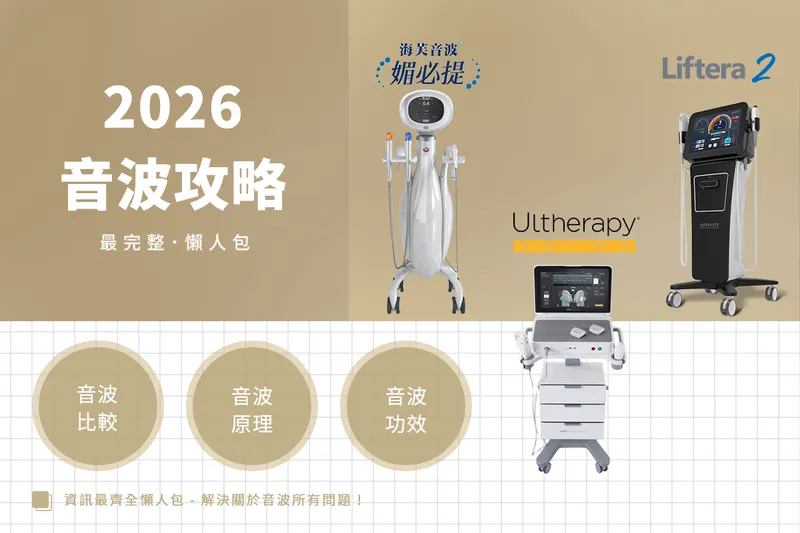
| Device features | Wide choice of handpieces and a broad treatment depth range; designed for Asian skin types and face shapes, with high handpiece fit; MMFU wide-area dual-focus technology | Slim handpiece with high conformity; innovative “linear handpiece” improves treatment efficiency | Real-time imaging monitoring | Micro-pulse technology; 20 treatment modes; faster (2.5 times faster than the previous-generation Ultraformer) |
| Target areas | Face, around the eyes, both cheeks, double chin, abdomen, buttocks, legs | Brows, midface, jowls, around the eyes, cheeks, jawline, double chin | Face, neck, around the eyes, chin, wrinkle reduction, jowls | Face lifting, firming the lower abdomen and thighs, improving fine lines, neck lifting, chin |
Golden Period Aftercare After Ultraformer
“Ultrasound lifting” uses focused ultrasound to generate heat that deeply tightens the SMAS fascia layer of the skin, producing a lifting and firming effect. One thing to note: after the treatment, the skin’s self-repair ability is lower than before, so it needs extra attention to repair-focused care. Good aftercare not only helps the skin recover better but also makes the ultrasound results twice as good for half the effort!
The best golden period is 7-10 days after the treatment. Be sure to do the three steps of moisturizing, soothing and sun protection.
1. Moisturizing: The most important thing after the treatment is moisturizing. The dermis has not yet returned to its original state, and the stratum corneum’s ability to lock in water is greatly reduced. At this point, if you do not moisturize well, a lot of water is easily lost, leaving the skin dry and rough, so moisturizing is especially important.
2. Soothing: After the treatment, the skin is in a more fragile state. Irritating skincare products, such as those with whitening agents, alcohol or acids, and heavy makeup that is hard to remove, can all cause secondary damage to the skin. Avoid them as much as possible for one to two weeks after the treatment, and choose gentle, non-irritating skincare products instead.
3. Sun protection: The skin is most sensitive and fragile in the first week after the treatment, so intensive sun protection is needed to effectively prevent secondary damage from UV rays. Use sun protection products of SPF 30-50 or higher, reapply every 2-3 hours when outdoors, and add physical sun protection such as an umbrella or hat for better protection.
This article is for general information only. Results vary from person to person; please consult a doctor in person before deciding on any treatment.