Contents
A belly is bad enough, but even your back view looks like an older woman's. What can you do about a predicament like this? Most of us don't have much time for the gym, and dieting makes it hard to slim down exactly the areas you want. That is when you need an assist treatment that helps you reduce fat quickly in a short time and sculpt the contours you want more smoothly: VASER liposuction. This article introduces and shares information on liposuction for different areas of the body, and at the end it covers the possible complications and side effects of the procedure. You no longer need to be anxious about your figure. Let's find out together!
Recommended Liposuction Technology: VASER Liposuction
VASER is the newest liposuction device available, using a titanium probe that is the most compatible with the human body, which releases ultrasound to create hundreds of fine bubbles that break large fat clumps into smaller clumps. A spiral water flow then separates the small clumps into distinct individual fat cells. The process involves no tearing injury and no stimulation from high-heat lasers, does not damage the surrounding blood vessels, nerves, or connective tissue, and effectively reduces bleeding, bruising, and pain, leaving the skin around the treated area firm rather than sagging after the procedure.
The fat extracted by VASER liposuction is of “high fineness” with a “high fat survival rate,” so it can be grafted back into other parts of the body. Whether it is the slim waist, ab lines, and rounded “peach” buttocks that many women want, or the six-pack and V-line that men pursue, it can even sculpt gynecomastia into attractive pecs! VASER liposuction removes both deep and superficial fat, achieving “deep liposuction, superficial sculpting”, so the contours of the body are sculpted to be even more toned.
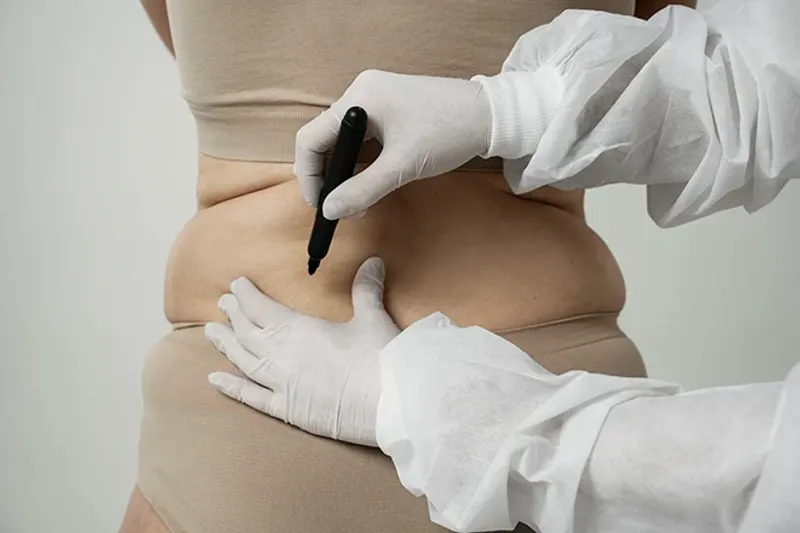
Abdominal Liposuction (Lower Back)
To have a defined lower back, the area needs to be down to “almost” no fat. During lower back liposuction, the doctor has to be especially focused and thorough in removing the fat so that the waist-to-hip ratio and a beautiful lower back curve show perfectly. The area most often overlooked in lower back liposuction is the fat that builds up at the “upper flank, below the bra strap”, so before surgery, make sure your doctor will remove fat from this area, to avoid the awkward situation of a lump of fat showing up again when you put on a bra after surgery. With a perfect lower back, anyone can have a head-turning back view!
Abdominal Liposuction (Front)
Before treating the flanks, the doctor usually marks out the rectus abdominis first. The areas on either side of the rectus abdominis are defined as the “flanks,” and we recommend removing fat more thinly here so that the waistline stands out clearly!
The area from the lower edge of the breasts to the navel is called the “upper abdomen” or “stomach bulge.” It looks different from person to person, and from the side it often gives the impression of a protruding belly, and unfortunately this fat is the “thickest” and “hardest” part of the abdomen. It is hard to treat well with traditional or manual liposuction. A firm fat layer like this calls for the “VASER liposuction” recommended above, which continually emulsifies and suctions the fat to thin and flatten it, giving you a beautiful upper abdomen!
Abdominal Liposuction (Lower Abdomen)
The lower abdomen often develops a “spare tire” or “pot belly” around the navel, which is also where fat builds up the most. Awkwardly, this area also has fat that is “thick and firm,” so VASER liposuction is likewise needed to emulsify the stubborn fat and thin it out as much as possible.
However, the lower abdomen has more skin and is more prone to loose skin, which can lead to an uneven surface. So if a consultation shows that a patient has “looser skin” and a “thicker fat layer,” the doctor will carefully decide how much fat to remove to avoid unevenness!
Abdominal Liposuction (Defining Lines)
Next, we must talk about “curves.” How can you do liposuction without getting any curves? First, though, you need to understand the structure of the body. Together with the spine, the human body forms an S-shaped curve, so the belly naturally tilts forward along with the spine. This means the belly will not become completely flat right after liposuction; a slight bulge will remain, and this is a natural phenomenon of the human body! (Even very slim women have a slight bulge when relaxed.)
Abdominal Liposuction Complications and Side Effects
Abdominal liposuction is one of the more difficult procedures among the many body areas, because many factors cause the abdomen to protrude, such as: loose skin, increased fat thickness, separation or thinning of the rectus abdominis, and more. Postpartum cases are even more complicated, with issues such as: abnormal fat accumulation caused by postpartum scar adhesions, which creates wrinkles, a deformed navel, stretch marks, and more. Choosing an experienced doctor is therefore very important. A doctor needs enough liposuction experience and also an aesthetic eye to avoid problems such as unevenness and overly loose skin.
The Three Most Common Complications of Liposuction:
- Cellulitis: an infection caused by incompletely sterilized cannulas or unhygienic liposuction tools.
- Tumescent solution toxicity: before liposuction, a tumescent solution containing lidocaine is injected. If too much is injected, it can cause toxicity, which may lead to disturbed sensation, dizziness, cramps, and in severe cases affect cardiovascular function and slow the heart rate.
- Fat embolism: when a large blood vessel is injured during liposuction, fat globules enter the bloodstream and travel to other parts of the body, causing organ failure. This is a very serious complication that depends heavily on the doctor's care, technique, and experience, so we remind you once more that choosing your doctor carefully is extremely important.
The “Dangers of Liposuction”! A Practical Summary to Help You Lower the Risks
What Should You Know About Aftercare?
Do not smoke or drink alcohol for one month after surgery, and avoid overly spicy foods or blood-activating herbal medicine, keep a normal routine, and do not stay up late. Proper care and precautions after liposuction are crucial for recovery and for maintaining results. Following your doctor's advice, eating sensibly, and gentle massage all help you achieve the results you want and boost your confidence. Keep in mind that everyone's recovery may differ, so consult your doctor and seek professional advice to make sure your recovery goes smoothly.
This article is for general information only. Results vary from person to person; please consult a doctor in person before deciding on any treatment.