Contents
- Risks of Breast Augmentation
- Problems That May Occur After Breast Augmentation
- Which Implants Are Recommended for Revision Breast Augmentation?
- Revision Breast Augmentation Surgery
- Precautions for Revision Breast Augmentation
- What Risks or Complications Can Occur After Revision Breast Augmentation?
- Cost of Revision Breast Augmentation
Breast augmentation is no longer novel, and implant materials keep evolving. Still, a small number of people are unhappy with their results after surgery. What should you do then? Is every material suitable for revision breast augmentation? The surgery has become more advanced and more common, yet online you still often see people sharing stories of "failed augmentation," "poor results," or "XXX implants are terrible." Does this surgery really still carry high risks? To address concerns about breast augmentation, our editors have put together the key points. Let's take a look!
Risks of Breast Augmentation
Breast augmentation is an invasive surgery that requires general anesthesia, so it does carry risks. Even though medical equipment is now quite advanced and the surgery is common, we still recommend choosing your doctor and clinic carefully to keep every risk as low as possible! The risks that commonly arise with breast augmentation include the following:
1. Implant positioned too high, uneven breast size or height, unnatural shape
These could happen with traditional surgery in the past, which would then require revision breast augmentation to make adjustments. Today's techniques are assisted by an endoscope, which greatly lowers the chance of this happening.
2. Hardening
Hardening of the implant is an early sign of capsular contracture. The capsule is the body's self-protection mechanism: it forms tissue around the implant and encases it, which can make the breast hard or even distorted.
3. Hematoma
Mostly occurs within 48 hours after surgery, with sudden, abnormal swelling, tightness, and pain in the breast. If this happens, seek medical care immediately so a professional doctor can help diagnose it. In severe cases, surgery is needed to remove the blood clot, and the implant can still be kept without being affected.
4. Implant slipping downward
This occurs in a very small number of patients. Because their tissue is looser, the implant may gradually slip downward due to insufficient support, so an underwire bra should be worn early on. To prevent slipping, a chest band is also usually recommended after surgery to avoid the risk of implant displacement.
5. Nerve injury
Breast augmentation requires separating the pectoralis major muscle or fascia in order to insert the implant. The nerves may be damaged to varying sizes and degrees, so reduced sensation, numbness, or oversensitivity of the nipples after surgery are all normal. Usually, recovery is complete, or at least about 70 to 80%, within one year after surgery, but in a few patients sensation may never return.
6. Anesthesia
Breast augmentation requires general anesthesia, so we recommend choosing a clinic with an anesthesiologist present for the surgery, to make sure that any emergency during the procedure can be dealt with in time!
What to do if capsular contracture occurs after breast augmentation?
What are the complications of breast augmentation? 3 tips to lower the chance of side effects!
Problems That May Occur After Breast Augmentation
After breast augmentation, the following situations may occur and lead patients to choose revision breast augmentation, such as: capsular contracture, implant rupture, implants positioned too high or too low, size not meeting expectations, saline implant leakage, and an unnatural breast shape. Of course, inadequate aftercare following surgery may also lead to wound infection.
Capsular contracture
After a breast implant is placed in the body, the immune system treats it as a foreign object and activates a self-defense mechanism, forming a thin, soft layer of scar-like fibrous tissue (the capsule) around the implant. When this scar tissue becomes thick and hard and keeps contracting inward, squeezing the implant until it is immobilized in its space, the breast not only feels hard but may also become painful and deformed.
Implant rupture
In general, with normal use after surgery, an implant will not leak or rupture, but poor aftercare or excessive massage can cause the implant to rupture!
Size not meeting expectations
Many patients online report after surgery that their cup size is too small or not what they expected, so they want a revision. This may come from insufficient communication with the doctor before surgery and a failure to clarify each other's expectations and plan. Of course, it may also be that the patient simply wants to go up another cup size.
Who shouldn't have breast augmentation? How surgery can help and who it suits
What are the complications of breast augmentation? Learn the right way to speed up recovery!
Which Implants Are Recommended for Revision Breast Augmentation?
If the goal of revision augmentation is simply to go up a cup size, you can choose the implant material you prefer.
P.S. A special reminder: if you have had capsular contracture in the past, choose an implant with a low capsular contracture rate!
But there is no need to be too confused or worried about which material to choose. Technology keeps improving, and almost all implants can now meet the standard of a low capsular contracture rate, so you can choose according to your personal preference and let your doctor help with the evaluation!
| Smooth-surface implants | Queen Wave | Perle | Sebbin | Motiva | |
|---|---|---|---|---|---|
| Manufacturer origin | United States | United States | United Kingdom | France | United States |
| Surgical incision | 3-4 | 3-4 | 3-4 | 3-4 | <3 |
| Warranty | No | 12 years | Lifetime warranty | Lifetime warranty | 10 years |
| Advantages | Natural movement during activity | AI-guided precision filling reduces rippling; lifetime peace-of-mind warranty | 100% filled, lifetime warranty, natural breast shape | No post-op massage needed, more compatible with soft tissue | Natural curves like a real breast |
| Capsular contracture rate | Needs massage to reduce | <1% | <1% | <1% | <1% |
| Post-op massage | Yes | No | No | No | No |
2024 Breast Implant Comparison: Mentor, Sebbin, Motiva, Perle, Which Suits You Best?
Sebbin, Mentor, Motiva, or Perle Breast Augmentation: Which Is Better? Implant Materials Revealed!
Revision Breast Augmentation Surgery
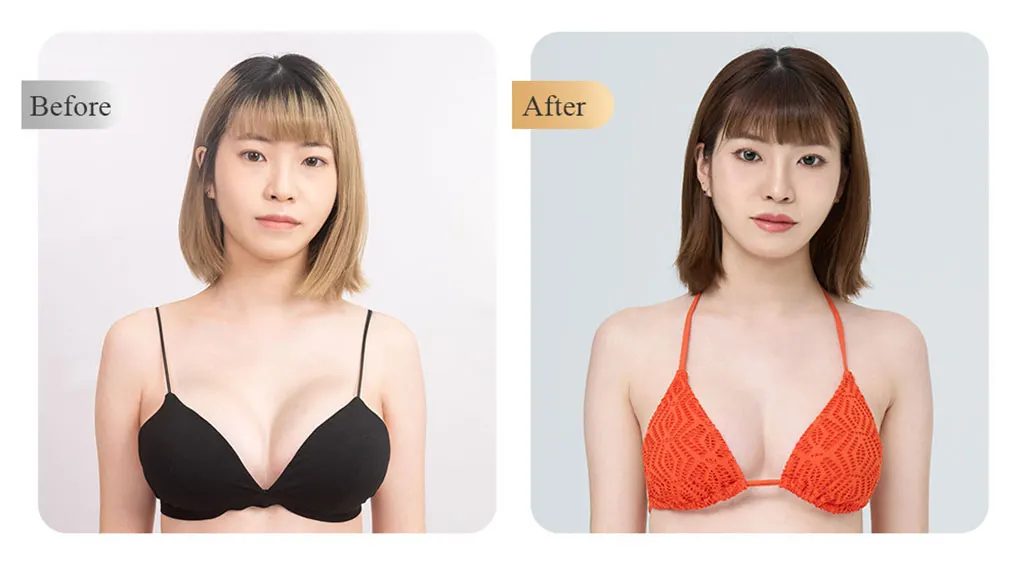
Because you have already had breast augmentation once, the pre-operative evaluation for revision surgery needs to be even more careful and thorough. We recommend that patients who want revision breast augmentation be sure to choose their doctor and clinic carefully. Please also note that for any breast augmentation, the first six months are an adjustment and settling period, and results during this time may not be as expected. Breast massage can help in the meantime, and waiting at least one year for observation is the best timing for treatment!
Common reasons for revision breast augmentation:
- Grade III to IV capsular contracture, an odd appearance, or ongoing discomfort in the breast.
- A height difference of more than 2 cm between the breasts
- Unable to create any cleavage
- Implant wrinkles that can clearly be felt
- Suspected implant leakage or rupture (an MRI scan at a hospital is recommended to confirm)
- Wanting to change the implant
Besides the situations above, many patients choose revision because they want to "go up a cup size" or feel the "implant they originally chose was too large." However, in terms of physical condition, revision breast augmentation carries a higher surgical risk than the first surgery, because the tissue in the body has already been disturbed by an outside object, so evaluation by a professional doctor is required before surgery to decide whether to proceed with revision surgery.
The most common reason for needing revision breast augmentation is capsular contracture. Capsular contracture can occur for the following reasons:
- Congenital predisposition.
- Hematoma after surgery.
- Seroma after surgery.
- Infection or inflammation after surgery.
- Biofilm formation: bacteria gather on the implant surface and form a film, causing chronic inflammation that leads to capsular contracture.
The purpose of revision surgery is to first remove the capsule so the breast returns to a soft state. Most doctors will remove the capsule through an incision at the lower breast fold or the lower edge of the areola. Techniques have also grown more advanced, so removal can be performed with the assistance of an endoscope
Revision breast augmentation steps:
- Before removing the old implant, separate the capsule first. Under the endoscope, it can be separated very precisely and without bleeding.
- Cut open the capsule and remove the old implant.
- Cut out the entire capsule and remove it.
- The complete capsules from both sides, cut out
Precautions for Revision Breast Augmentation
- For the first week after surgery, clean by sponge bathing and keep the wound dry to prevent infection; from the second week on, you can shower!
- For one month after surgery, do not sleep on your stomach or bump your breasts hard, to avoid hematoma.
- For one month after surgery, avoid movements that strain or pull with your arms, such as lifting heavy objects or carrying a child.
- Avoid spicy and irritating foods. Smoking, alcohol, and herbal medicine and supplements should also be stopped temporarily to prevent swelling or interference with wound healing.
- Don't drink too much water before bed. If your chest feels swollen, raising your upper body with a pillow while sleeping can ease the discomfort.
- Wear bras that are non-underwire, non-gathering, and non-lifting, or wear a chest band.
- After surgery, besides swelling in the breasts, the abdomen and back may also swell as edema spreads! A warm compress can help relieve this.
What Risks or Complications Can Occur After Revision Breast Augmentation?
The risks of revision breast augmentation are similar to those of the first surgery. Compared with primary augmentation, the chances of infection, hematoma, and similar risks are low, but there may be a risk of nipples at uneven heights. As for capsular contracture, which many people worry about, as long as the capsule is completely removed before revision surgery and aftercare is good, the risk is basically reduced as well.
Cost of Revision Breast Augmentation
The cost of revision breast augmentation is affected by the following factors:
- Incision location
- Severity of the capsule
- Whether suturing for fixation is needed
- Whether fat grafting is needed
- Whether the implant needs to be replaced, and the implant material
It is generally somewhat more expensive than the first surgery, but because everyone's situation is different, an in-person consultation and evaluation is needed before we can give an estimated price!
This article is for general information only. Results vary from person to person; please consult a doctor in person before deciding on any treatment.