Contents
- How RF Skin Tightening Works: Monopolar, Bipolar, or Multipolar? Choose Your Anti-Aging Depth by “Polarity”
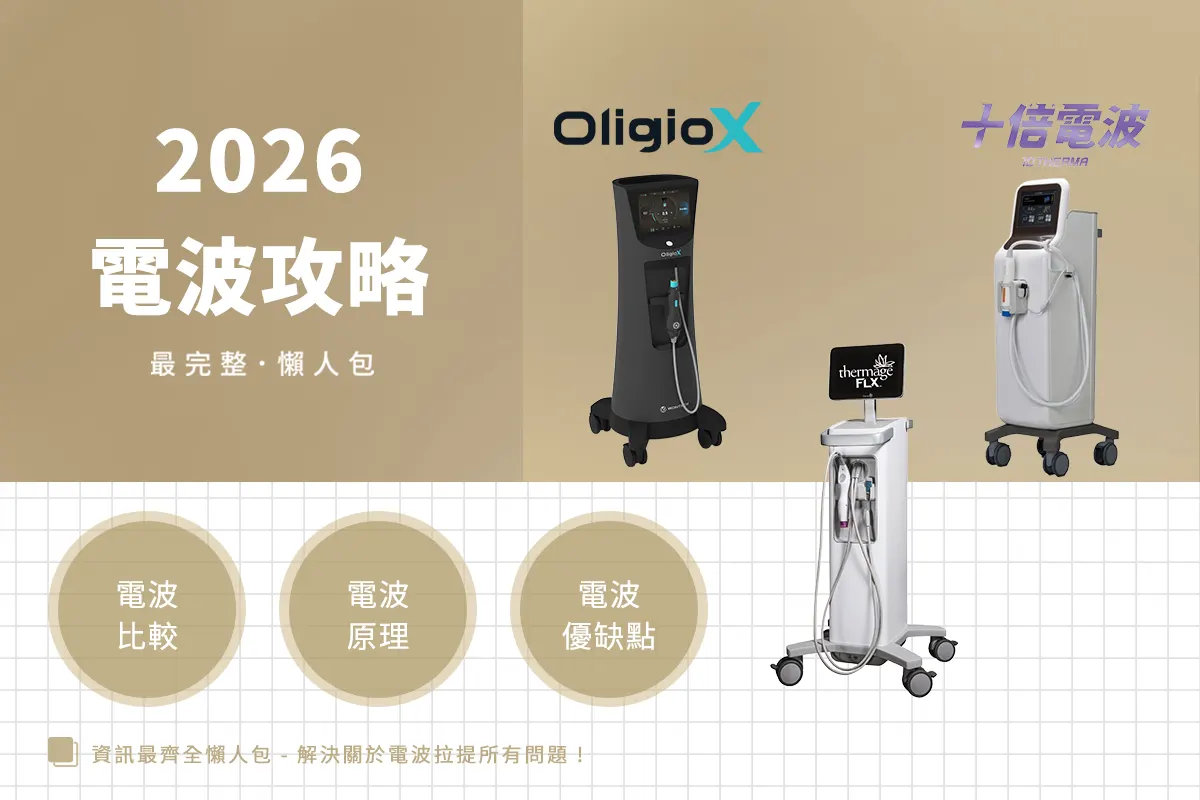
- 2026 Monopolar RF Comparison: Thermage FLX, Oligio X, and 10Therma Complete Guide
- Pros and Cons of RF Skin Tightening: 5 Advantages and 2 Limitations
- Are There Side Effects from RF Skin Tightening? A Physician Explains the Truth About Recovery
- How to Care for Your Skin After RF Treatment? A Physician’s Golden Rules for Aftercare
- Why Do RF Prices Vary So Much? A Physician Reveals the Costs and Potential Traps
- RF Skin Tightening: Precautions
- FAQ
- References
Once you pass 25, the collagen in your body is lost at an astonishing rate. Among treatments that pursue “reverse aging,” RF skin tightening, with its natural, gradual anti-aging effect, has always been a top choice among both aesthetic beginners and seasoned skincare enthusiasts.
Faced with the bewildering range of devices on the market, are you also unsure how to choose? This article takes an in-depth look at the technical advantages of monopolar RF and objectively compares three flagship devices, Thermage FLX, Oligio X, and 10Therma, to help you pinpoint, from pain level to budget to desired results, the anti-aging prescription that suits you best.
How RF Skin Tightening Works: Monopolar, Bipolar, or Multipolar? Choose Your Anti-Aging Depth by “Polarity”
Before comparing the major devices, we need to clarify one fact: “Not every heating-based aesthetic device can be called ‘skin tightening.’”
RF skin tightening uses high-frequency current to generate 55-65°C heat that stimulates collagen, but many devices on the market that advertise “RF” can only act on the epidermis and are helpless against true sagging of the contour.
So why is there such a gap? The key lies in whether “volumetric heating” technology is truly achieved. To keep you from being confused by the many terms, the NAISS physician team will look at it from the perspective of the “current circuit” and divide the technology into three categories.
1. Monopolar RF: The King of “Deep Lifting”
This is currently the mainstream of medical-grade anti-aging.
- How to identify it: During treatment, a “return pad” must be attached to your body.
- How it works: Current starts from the probe and passes through the epidermis and dermis, going all the way down to the fascia layer 4.3 mm below the skin, and finally flows to the pad on your body to complete the circuit.
- Advantage: This way of penetrating produces “3D volumetric heating”, with temperatures reaching 65-72°C. The whole block of tissue heats evenly from the inside out, contracting soft tissue over a wide area and at depth.
- Suitable for: People with facial laxity, deep nasolabial folds, or a blurred contour line.
- Common devices: Thermage FLX, Oligio X, 10Therma, IntraGen, and CPT (Gold RF).
2. Bipolar RF: The Specialist for “Skin Texture and Acne Scars”
- How to identify it: The probe usually has “microneedles,” making this a minimally invasive treatment.
- How it works: Fine microneedles are inserted into the skin, and current flows only between the positive and negative poles of the needles (targeted heating). It causes mild physical disruption of the skin structure, triggering the repair mechanism.
- Advantage: Heat is concentrated in the superficial dermis, so it is highly effective for “scar revision”, “stretch marks”, and “enlarged pores.”
- Suitable for: Severe acne scars, cellulite, or rough skin texture.
- Common devices: Morpheus8, Sylfirm, Genius, and Profound.
3. Multipolar RF (Tripolar RF): The Choice for “Painless Maintenance”
- How to identify it: The probe has 3 or more conductive points, and no pad or microneedle insertion is needed.
- How it works: Current forms a circuit between multiple electrodes on the probe, heating a wider area but with more dispersed energy.
- Limitation: Heating temperature is milder (about 40-52°C), and penetration depth is shallower, so it cannot reach the fascia layer the way monopolar RF does.
- Suitable for: Those who are pain-averse, want regular everyday maintenance, or want an “emergency de-puffing” before an important event or improvement of superficial fine lines.
- Common devices: EndyMed, and some beauty and skincare devices.
At a Glance: Which Type of RF Do You Need?
| Monopolar RF | Bipolar RF | Multipolar RF | |
|---|---|---|---|
| Heating Depth | Deep (up to 4.3 mm) | Shallow to medium | Superficial |
| Temperature | 65-72°C | Targeted heating | 40-52°C |
| Invasiveness | Non-invasive (pad required) | Minimally invasive (microneedles) | Non-invasive (comfortable) |
| Representative Devices | Thermage FLX, Oligio X, 10Therma | Morpheus8, Genius, Sylfirm | EndyMed |
| NAISS Physician-Recommended Indications | Facial laxity, blurred jawline, those wanting a clearly noticeable lift | Severe acne scars, enlarged pores, stretch marks, rough skin texture | Pain-averse, regular maintenance, fine lines around the eyes |
2026 Monopolar RF Comparison: Thermage FLX, Oligio X, and 10Therma Complete Guide
Now that you have passed the screening in the previous section and confirmed that you need “monopolar RF” with fascia-lifting effects, the next challenge is: how should you spend your budget?
NAISS CLINIC has selected the three flagship devices from the “American and Korean” camps that are the most talked about on the market. Looking at their “energy output logic”, “pain comfort”, and “treatment efficiency”, we analyze the strengths and arenas of these three devices, all of which reach a depth of 4.3 mm.
1. American: Thermage FLX, the Top-Spec Flagship for Ultimate Results
As the originator of RF skin tightening and the market benchmark, the 4th-generation Thermage FLX is still the device with the highest market share worldwide and the gold standard in the minds of many physicians.
- Core technology: AccuREP™ smart energy optimization – This is FLX’s strongest moat. Before every shot, it automatically detects the skin’s electrical resistance at that spot and fine-tunes the energy output. It’s like having “automatic navigation correction” while driving, ensuring that every shot of energy, whether on the forehead (thin skin) or the cheek (more flesh), precisely reaches the set heat.
- Advantage: strongest energy per session, long-lasting results – With highly stable energy output, a single Thermage treatment usually gives the most noticeable result. Although the pain level is around 3 stars, it provides a maintenance period of up to 12-18 months. It is very suitable for mature skin with obvious collagen loss, or people who feel their face has ‘skin detached from the tissue beneath, lacking support’ and want deep tightening from a single treatment.
- Doctor’s review: “Thermage is like the Hermès of aesthetic medicine. Its energy output is very ‘solid.’ Although the price is higher and some probes have a time-lock limit, if your budget allows and you want to ‘do it just once a year and get it done right,’ Thermage is still the recommended first choice.”
2. Korean: Oligio X, the Ultimate Evolution in Pain Management and Efficiency
If the older Oligio was the “little Thermage,” then the new-generation Oligio X is an evolved version with cheat codes. It not only keeps the advantage of being designed specifically for Asian skin, but also pushes “comfort” to the ceiling.
- Core technology: exclusive GXG deep-and-superficial heating mode and 3D cooling spray – Oligio X’s biggest breakthrough lies in the GX mode, which fires energy continuously at extremely high frequency to stack heat quickly. Combined with an upgraded cryogen spray system, the epidermis hardly feels any burning, giving a treatment comfort of 5 stars.
- Advantage: ultra-fast treatment, customizable shot count – A full-face treatment can be completed in as little as 20-30 minutes. And unlike Thermage, which has strict probe time limits, Oligio X’s shot configuration is highly flexible, and the physician can plan 300-900 shots according to your budget, making it ideal for customized reinforcement of localized laxity (such as jowls and double chin).
- Doctor’s review: “Oligio X breaks the myth that ‘pain equals effectiveness.’ Many clients who used to cry through Thermage react after switching to Oligio X with: ‘It really doesn’t hurt much, but is it working?’ Yet the firmness after treatment can’t be faked! Recommended for the pain-averse, aesthetic beginners, and anyone who wants maintenance every six months.”
3. Korean: 10Therma, the Efficiency Monster for Large-Area Treatment
A dark horse that emerged in 2024-2025, it focuses on “wider, broader” treatment efficiency.
- Core technology: 5.0 cm² extra-large probe – This is the facial probe with the largest area on the market (25% larger than Thermage and Oligio). This means that with the same number of shots, 10Therma delivers a broader heating effect to the tissue, with extremely high coverage per shot.
- Advantage: a boon for larger faces, high value for money – Because the probe is larger, energy is dispersed more evenly, and its comfort falls between Thermage and Oligio, at about 4 stars. For clients with a larger facial area, or who want to treat the neck at the same time, it is highly efficient.
- Doctor’s review: “10Therma’s strength is large-area coverage. Although it is slightly less refined and customizable than Oligio X, it performs well on widespread laxity. Its price and pain level both fall right between Thermage and Oligio, making it suitable for people looking for a middle-ground option.”
Full Comparison Table: 3 RF Lifting Devices
| Thermage FLX | Oligio X | 10Therma | |
|---|---|---|---|
| Origin | USA (Solta Medical) | Korea (WonTech) | Korea (Tentech) |
| Exclusive Advantage | AccuREP™ technology Automatically detects resistance; most solid result per session | Strong pain management Optimized cooling spray; top choice for the pain-averse | 5 cm² large probe Large coverage area, high treatment efficiency |
| Probes | Total Tip (Purple Diamond) Classic Tip (Blue Diamond) Eye Tip Body Tip (Gold) | Face/neck probe Eye-area probe | Bright Eye probe Tightening probe Tightening probe PLUS Body probe |
| Treatment Depth | 4.3 mm (fascia layer) | 4.3 mm (fascia layer) | 4.3 mm (fascia layer) |
| Comfort | ★★★ (noticeable) | ★★★★★ (very comfortable) | ★★★★ (comfortable) |
| Treatment Time | 60 minutes | 30 minutes | 40 minutes |
| Price Range | ★★★★★ (high) | ★★★ (affordable) | ★★★★ (medium) |
| Duration of Results | 1 – 1.5 years | About 1 year | About 1 year |
| Suitable For | Ample budget, seeking the ultimate result, once a year | Pain-averse, budget-conscious, regular maintenance | Large-area treatment, efficiency seekers |
Pros and Cons of RF Skin Tightening: 5 Advantages and 2 Limitations
Although RF skin tightening is the mainstream of non-invasive anti-aging, it is by no means a cure-all. Understanding its advantages, disadvantages, and potential side effects ensures that your expectations match your results after treatment.
5 Advantages of RF Skin Tightening
- Non-invasive, efficient maintenance: RF needs no scalpel and leaves no wounds, so you can complete treatment with almost no downtime and return directly to daily life afterward.
- Natural beauty that avoids the “aesthetic-treatment look”: RF results do not appear overnight, but come from collagen self-remodeling over several months, so the facial contour tightens “gradually.”
- Comprehensive tightening coverage: From aging-prone fine lines around the eyes and neck lines to postpartum abdominal laxity, RF delivers precise thermal repair through different dedicated probes.
- Not just lifting, but skin renewal: While tightening the contour, the heat also performs “micro-repair” on the dermis. This effectively shrinks pores and softens fine lines, helping skin that is rough from laxity regain delicate elasticity.
- 1+1>2 combination treatments: It is highly compatible with other treatments. Whether you want to pair it with ultrasound for stronger deep lifting, or combine it with hyaluronic acid filler to fill hollows and Botox to soften expression lines, RF serves as the “foundation” of anti-aging and complements other treatments.
2 Limitations of RF Skin Tightening
- Results vary by person: If your skin condition involves moderate to severe separation of skin from the tissue beneath, or you are of advanced age with very low self-repair capacity, energy heating alone will have limited effect. In that case, we would instead suggest evaluating traditional facelift surgery to resolve the problem thoroughly.
- Regular maintenance needed: Anti-aging is a long game, and no non-invasive treatment is permanent. To keep your skin consistently full and firm, we suggest treating RF as “premium maintenance” and returning regularly for treatment to sustain the best condition.
Are There Side Effects from RF Skin Tightening? A Physician Explains the Truth About Recovery
The results and risks of aesthetic treatments often coexist. Only with the right expectations before treatment can you avoid unnecessary disputes and maximize your satisfaction afterward.
1. Expected Reactions on the Way to “Looking Better”: Normal Effects vs. Side Effects
Most people worry that RF will leave them with a “swollen, puffy face” or “disfigured” afterward. In fact, when performed by a physician trained by the manufacturer, serious complications are extremely rare.
The following are normal clinical reactions that may appear within 1 week after treatment, which indicates that the heat is at work, so there is no need for undue anxiety:
- Instant redness and warmth: Because RF uses heat to stimulate collagen, slight redness, warmth, or mild itching right after treatment is normal and usually subsides naturally within 30 to 60 minutes.
- The skin’s “thirsty period”: After high-heat treatment, the epidermis temporarily loses water. If you feel dryness, tightness, or slight peeling in the days afterward, extra moisturizing will relieve it.
- Rare pigment reactions: Temporary post-inflammatory hyperpigmentation (darkening) occurs at a very low rate, usually due to individual constitution or excessive energy stacking, and mostly metabolizes on its own within 3 to 6 months.
2. Pitfall Guide: Why Do Some People Get Blisters or Burns After Treatment?
The occasional “RF disfigurement” cases in the news are never a problem with the treatment itself, but come from the following two man-made risks:
- Inexperienced physician: The physician fails to precisely adjust the energy to the skin thickness and resistance of different areas, leaving energy on the same spot too long and causing thermal injury.
- Devices or probes of unknown origin: Tempting low-price “cracked probes” or “counterfeit machines” have extremely unstable energy output and easily cause burns, blisters, and other acute emergencies.
How to Care for Your Skin After RF Treatment? A Physician’s Golden Rules for Aftercare
Although RF skin tightening is advertised as having “no downtime,” after taking high-energy heat the skin is in a critical period of collagen remodeling. NAISS physicians have compiled the golden rules of aftercare to make sure your recovery is comfortable, safe, and effective.
The 3 Don’ts and 3 Dos of Aftercare
- ❌ Don’t rush into “whitening” or “exfoliating”: For one week after treatment, the skin barrier is more sensitive. Please stop using products containing retinoids, AHAs (fruit acids), alcohol, or high-concentration vitamin C to avoid inflammation or darkening.
- ❌ Don’t go to “high-heat places”: For one week, stay away from hot springs, saunas, ovens, and overheated yoga studios. We want the heat to stay in the deeper layers rather than put extra burden on the surface.
- ❌ Don’t pick or scratch: If very slight scabbing or peeling appears, that is a normal part of tissue repair; please let it fall off naturally.
- ✅ Do boost “moisture”: Skin becomes very “thirsty” after heat. We recommend using a medical-grade moisturizing serum or mask morning and night for one week after treatment.
- ✅ Do be thorough with “sun protection”: UV is collagen’s number one enemy. Be sure to use sunscreen of SPF 30 or higher after treatment to protect the fragile recovery period.
- ✅ Do watch for “redness and swelling”: The redness and warmth right after treatment usually subside within 30-60 minutes. If redness and swelling last more than 24 hours, or abnormal blisters appear, contact the clinic immediately.
Why Do RF Prices Vary So Much? A Physician Reveals the Costs and Potential Traps
In the aesthetic market, RF skin tightening quotes range from tens of thousands to over NT$100,000, and this huge gap often comes from “brand premiums,” “consumable limits,” and most importantly “medical safety costs”. As a smart consumer, understanding the pricing logic behind this ensures every dollar of your budget is well spent.
1. Consumable Pricing Logic: American “Locked Probes” vs. Korean “Customizable Flexibility”
The basic cost of RF skin tightening comes mainly from single-use consumable probes.
- American devices (e.g., Thermage FLX): The manufacturer’s probes have a patented chip identification and time-lock mechanism; once opened and in contact with skin, they must be used up within a set number of hours. Probes such as the Total Tip, Body Tip, and Eye Tip all have a fixed total shot limit (such as 450, 600, or 900 shots), so the price is higher and fixed, with the market rate for a full face at around NT$100,000-150,000.
- Korean devices (e.g., Oligio X): They break the traditional probe time limit, focusing on “customizable shot counts.” The physician can flexibly plan the number of shots according to the patient’s local needs (e.g., reinforcing only the jawline), which both improves treatment efficiency and makes the price more affordable, suitable for regular maintenance.
2. Why Do Some Clinics Quote “Below Market Rate”? Beware of These 3 Pitfalls
If you encounter a quote far below the market rates above, be on guard for the following risks:
- Concerns about device source and maintenance: Some clinics use “rented machines” to avoid the high costs of purchase and regular servicing. For devices without regular manufacturer calibration, the stability of energy output is questionable and the risk of burns rises.
- Illegal “cracked” or gray-market probes: This is the main way unscrupulous operators cut costs. With recycled, cracked probes, the cooling membrane on the surface may be damaged, which not only greatly reduces results but may also cause serious burns and blisters.
- Physician expertise and treatment plan: An experienced physician must have precise judgment of anatomy, resistance detection, and energy control. Low-price treatments often cut the physician’s consultation time and overlook the safety assessment of individual skin conditions.
3. A Physician’s First-Hand Advice: How to Avoid the “Fake Low Price” Trap?
Before any RF treatment, the professional team at NAISS CLINIC verifies the manufacturer’s anti-counterfeit protection, making sure the machine carries the anti-counterfeit holographic label, and opens a brand-new probe in front of you.
- Doctor’s perspective: “RF fees buy not just those hundreds of shots of energy, but also the physician’s technical judgment and the manufacturer’s safety assurance.” Choosing a clinic with reasonable, transparent pricing is the best-value decision in your anti-aging investment.
RF Skin Tightening: Precautions
Before Treatment
- Avoid excessive sun exposure
- If the treatment area has had filler injections, surgery, or thread lifts within the past six months, please tell your physician in advance
- Treatment is not recommended for those with heart disease, pregnant women, or those with a pacemaker
- Avoid spicy, heat-inducing, or allergenic foods to prevent excessive redness and irritation
- Do not wear any metal jewelry on the day of treatment
After Treatment
- For one week, avoid irritating skincare products (e.g., acids, alcohol)
- For one week, avoid hot springs, saunas, and other high-heat places
- Boost moisturizing and sun protection
- Redness, swelling, and slight stinging for a few hours after treatment are normal reactions
FAQ
How long does RF skin tightening last? How often should it be done?
Usually results appear within 1-4 weeks after treatment and are most noticeable after about 3-6 months. Duration depends on the RF device, lifestyle habits, and aging speed of each person, and is usually 6-24 months. We suggest returning to the clinic 6-12 months after treatment so the physician can evaluate whether another treatment is needed.
Does RF skin tightening hurt?
Pain varies from person to person. Microneedle RF may cause a slight needle-prick sensation, while monopolar RF devices on the market have all been adjusted to reduce pain, and some models are marketed as painless.
What age is suitable for RF treatment?
Collagen begins to decline gradually at around age 25 on average, and most clients start RF treatments around ages 30-40. The actual situation is subject to on-site physician evaluation.
How can I tell whether a probe is genuine?
During treatment, ask the medical team to open the probe’s outer box in front of you, and check that the box carries the manufacturer’s anti-counterfeit holographic label.
References
This article is for general information only. Results vary from person to person; please consult a doctor in person before deciding on any treatment.